
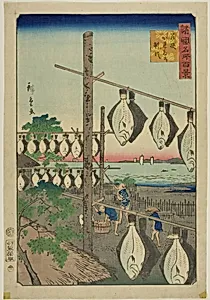
Strung-up Flounder, Wakasa Province (Wakasa karei o sasu) from the series “One Hundred Famous Views in the Various Provinces (Shokoku meisho hyakkei)”
Medium
Color woodblock print
Classification
woodblock print
Department
Arts of Asia
Museum
Art Institute of Chicago
Accession Number
196745
Rights
Public Domain
Art Historical Context
In the vibrant tradition of ukiyo-e woodblock prints, *Strung-up Flounder, Wakasa (Wakasa karei o sasu)* from the series *One Hundred Famous Views in Various Provinces (Shokoku meisho hyakkei)* captures a slice of everyday coastal life in 1859 Japan. Created by Utagawa Hiroige II (also known as Shigenobu a talented pupil of the master landscape artist Hiroshige I, this print belongs to a celebrated series that toured viewers through Japan's provinces, much like Hiroshige I's iconic *Fifty-three Stations of the Tōkaidō*. Hiroshige II's style echoes his mentor's poetic sensitivity to nature and human activity, blending meticulous detail with atmospheric depth. The color woodblock print medium—produced through labor-intensive carving of multiple blocks for precise color layering—highlights the technical brilliance of Edo-period artisans. Here, the focus on a strung-up flounder in Wakasa Province (modern-day Fukui Prefecture) evokes the region's rich fishing heritage, transforming a humble scene into a symbol of local bounty and seasonal rhythms. Such prints were affordable and widely circulated, democratizing art and fostering national pride amid Japan's late feudal era. This work, held in the Art Institute of Chicago's Arts of Asia collection, exemplifies ukiyo-e's enduring appeal: a window into fleeting beauty and cultural identity, inviting us to savor the poetry in the ordinary.
About the Artist
Utagawa Hiroshige II (Shigenobu) · 1826–1869
Utagawa Hiroshige II, born Suzuki Chinpei in 1826, was one of the most accomplished ukiyo-e artists of mid-nineteenth century Japan. He entered the studio of the celebrated landscape master Utagawa Hiroshige I — known for his iconic series "The Fifty-three Stations of the Tokaido" — and proved himself the most talented of the elder artist's few students. So highly regarded was the young pupil that...