
Stucco Fragment
Unknown Artist
probably 8th–12th century
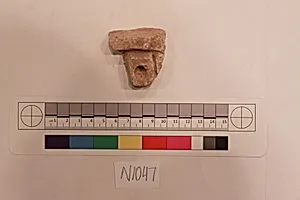
Medium
Stucco; carved, painted
Dimensions
H. 1 15/16 in. (5 cm) W. 1 3/4 in. (4.5 cm) D. 13/16 in. (2 cm)
Classification
Stucco
Department
Islamic Art
Museum
Metropolitan Museum of Art, New York, NY
Credit
Rogers Fund, 1948
Accession Number
48.101.1349
Rights
Public Domain
Art Historical Context
This delicate stucco fragment, likely from the 8th–12th century, offers a glimpse into the refined artistry of Islamic architecture. Measuring just under 2 inches tall, wide, and deep, it exemplifies the intricate scale of ornamental details used to adorn mosques, palaces, and madrasas across the Islamic world during the Abbasid and early Seljuk periods. Crafted from stucco—a molded plaster made from gypsum, lime, and water—this small piece was carved in relief and painted, techniques that allowed artisans to create textured patterns with vibrant colors, enhancing both light play and visual depth. Stucco's popularity in Islamic art stemmed from its versatility and affordability compared to stone carving, enabling widespread decoration in regions from Iraq to Iran and Central Asia. The carving likely features motifs such as arabesques, geometrics, or floral elements—hallmarks of aniconic Islamic design that emphasized harmony, infinity, and spiritual symbolism over human figures. Though the exact provenance is unknown, its preservation highlights the fragility of these architectural fragments, often salvaged from ruined structures. Today, housed in The Metropolitan Museum of Art's Islamic Art Department (acquired via the Rogers Fund in 1948), this fragment invites visitors to appreciate the anonymous mastery behind Islamic splendor—where every curve and hue contributed to transcendent spaces.