
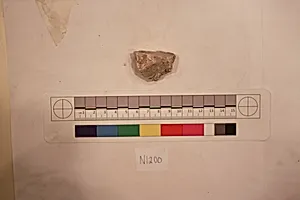
Stucco Fragment
Unknown Artist
probably 8th–12th century
Medium
Stucco; carved, painted
Dimensions
H. 1 3/16 in. (3 cm) W. 1 3/16 in. (3 cm) D. 9/16 in. (1.5 cm)
Classification
Stucco
Department
Islamic Art
Museum
Metropolitan Museum of Art, New York, NY
Credit
Rogers Fund, 1948
Accession Number
48.101.1502
Rights
Public Domain
Art Historical Context
This delicate stucco fragment, dating to the 8th–12th, offers a glimpse into the refined artistry of Islamic architecture during a golden age of cultural flourishing under dynasties like the Abbasids Fatimids. Measuring just 1 3/16 inches square and less than an inch deep, it was likely part of a larger decorative panel adorning mosques, palaces, madrasas in regions spanning Iran, Iraq, or North Africa. Acquired through the Rogers Fund in 1948, it now resides in the Metropolitan Museum of Art's Department of Islamic Art. Crafted from stucco—a versatile plaster-like material— the fragment was intricately carved to create raised motifs and then painted for vibrant color and depth. This technique allowed artisans to produce complex patterns, such as geometric interlaces or floral arabesques, embodying Islamic art's emphasis on abstraction and infinite repetition, which symbolized spiritual harmony and avoided figurative representation. Though small and anonymous, this piece highlights the extraordinary skill of medieval Islamic craftsmen, who transformed everyday materials into architectural splendor. It invites visitors to imagine the grand halls it once embellished, whispering tales of a world where beauty was woven into every surface.