
Stucco Fragment
Unknown Artist
probably 8th–12th century
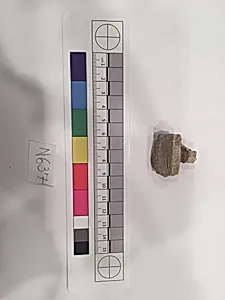
Medium
Stucco; carved
Dimensions
H. 1 3/16 in. (3 cm) W. 1 in. (2.5 cm) D. 13/16 in. (2 cm)
Classification
Stucco
Department
Islamic Art
Museum
Metropolitan Museum of Art, New York, NY
Credit
Rogers Fund, 1948
Accession Number
48.101.939
Rights
Public Domain
Art Historical Context
This delicate stucco fragment, likely carved between the 8th and 12th centuries, offers a glimpse into the refined architectural decoration of the medieval Islamic world. Measuring just over an inch in height, width, and depth, it the exquisite craftsmanship of early Islamic artisans working in regions from Iraq to Iran and North Africa. During this period, stucco mixture of gypsum, lime, and water—was prized for its versatility, allowing sculptors to create intricate reliefs adorning mosques, palaces, madrasas. The carving technique involved modeling wet stucco into molds or freehand, then incising fine details once dry, often featuring geometric patterns, arabesques, or floral motifs symbolizing paradise gardens in Islamic cosmology. Though the exact design of this fragment is subtle due to its size, such pieces were integral to larger wall panels, enhancing interiors with light-reflecting textures that played with shadow and depth. Acquired through the Rogers Fund in 1948 and housed in the Metropolitan Museum of Art's Islamic Art department, this artifact underscores the enduring legacy of Islamic decorative arts. It reminds visitors how everyday materials were transformed into objects of spiritual and aesthetic beauty, bridging cultures across centuries.