
Stucco Fragment
Unknown Artist
probably 8th–12th century
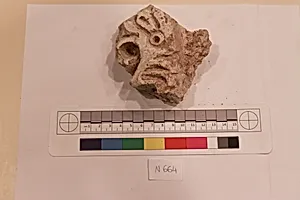
Medium
Stucco; carved
Dimensions
H. 3 9/16 in. (9 cm) W. 3 1/8 in. (8 cm) D. 1 3/5 in. (4.5 cm)
Classification
Stucco
Department
Islamic Art
Museum
Metropolitan Museum of Art, New York, NY
Credit
Rogers Fund, 1948
Accession Number
48.101.966
Rights
Public Domain
Art Historical Context
This delicate **Stucco Fragment**, dating to the 8th–12th century, offers a glimpse into the refined world of Islamic architectural decoration. Housed in the Metropolitan Museum of Art's Islamic department (acquired via the Rogers Fund 1948), this tiny carved piece—measuring just 3 9/16 inches high 3 1/8 inches wide, and 1 3/5 inches deep— once adorned a wall, niche, or arch in a mosque, palace, or private residence across the vast Islamic world, from the Abbasid heartlands to regional centers. Stucco, a molded and carved plaster made from lime, sand, and fibers, was a favored medium during this era for its workability and affordability. Artisans skillfully incised it with fine tools to create intricate surface reliefs, blending functionality with artistry. Though the specific design details are not preserved in full, such fragments highlight the period's mastery of ornamental carving, often featuring vegetal motifs, geometric patterns, or calligraphy that evoked spiritual harmony and infinite beauty. As a survivor from medieval Islamic culture, this unassuming relic underscores the era's emphasis on lavish yet ephemeral decoration, where architecture became a canvas for divine inspiration. A testament to anonymous craftsmanship, it invites us to ponder the grandeur of structures long vanished.