
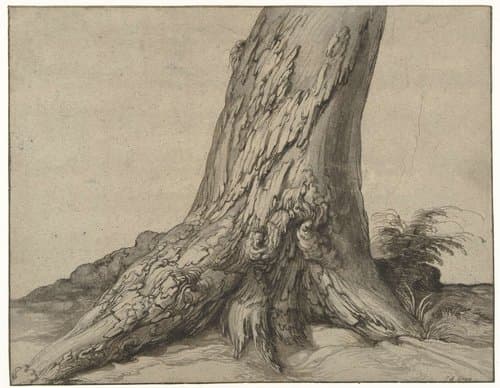
Studie van de stam van een boom met wortels
1575 - 1625
Medium
pen
Dimensions
280; 219
Rights
Public Domain
About this artwork
pen en penseel in donkerbruin en zwart krijt op grijs kardoespapier
Art Historical Context
Jacques de Gheyn II (5–1629), a masterful Dutch draughtsman and painter active during the transition from Mannerism to the early Baroque, created this intricate *Studie van de stam een boom met wortels (Study of a Tree Trunk with Roots) between 1575 and 1625. Renowned for his hyper-detailed studies of the natural world—ranging from flowers and insects to shells and landscapes—de Gheyn bridged artistic observation with emerging scientific curiosity in the Netherlands. This modest yet captivating drawing exemplifies his fascination with nature's raw textures and forms. Executed in pen and brush with dark brown and black chalk on gray prepared paper (kardoespapier), the work measures a compact 219 × 280 mm. This technique, popular among Northern European artists of the period, allowed for subtle tonal modeling and dramatic contrasts, evoking depth and volume in the gnarled bark and twisting roots. The toned ground enhanced highlights and shadows, making the tree trunk appear almost sculptural—a hallmark of de Gheyn's precision that influenced later still-life and botanical masters. As a preparatory study, it reflects the Dutch Golden Age's growing emphasis on empirical observation, prefiguring the meticulous naturalism of artists like Jan van Huysum. Visitors will appreciate how de Gheyn's keen eye transforms humble roots into a meditation on life's resilient underbelly, inviting us to marvel at nature's quiet drama.