
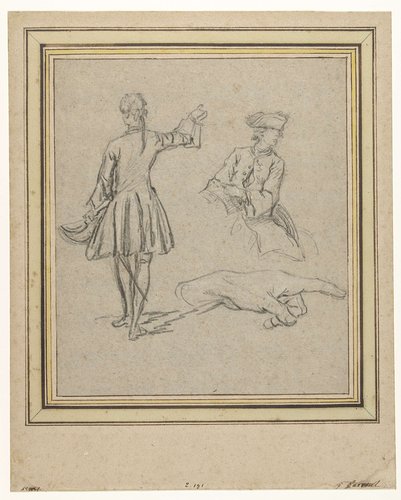
Studieblad met een staande man
1698 - 1752
Medium
paper
Dimensions
213; 246
Rights
Public Domain
About this artwork
annotation, recto, on the old mount, lower right, pen and brown ink: ‘j Parrocel’
Art Historical Context
**Studieblad met een sta man** by Charles Parrocel (8–1752) is a captivating 18th-century study sheet paper, measuring a modest 246 mm high by 213 mm wide. Parrocel, a French and engraver from a family of artists, specialized in battle scenes, equestrian subjects, and lively figures. This work, likely a preparatory drawing from his active career spanning the late Baroque to early Rococo periods, exemplifies artist's focus on the human. The title, translating from Dutch as "Study Sheet a Standing Man," suggests detailed sketch of a male figure in repose, a common practice among artists honing their anatomical precision for grander compositions. Study sheets like this were essential tools in the artist's studio, allowing for quick captures of poses, proportions, and movement. Parrocel's technique reflects the period's emphasis on pen and ink for fluid, expressive lines—evident in the surviving annotation on the recto of the old mount, lower right: "j Parrocel" in pen and brown ink. This inscription, possibly his monogram, authenticates the sheet and hints at its provenance through historical mounting practices. As a window into Parrocel's workshop, this intimate drawing offers museum visitors a glimpse of the meticulous groundwork behind his vibrant paintings. Its survival underscores the cultural value of such ephemera, preserving the creative process of an artist who bridged French academic traditions with emerging Rococo vitality.
About the Artist
Charles Parrocel · 1688–1752
Known for his paintings of battles and hunts. He also painted a number of equestrian portraits, including that of Louis XV in 1724. Comment on works: Landscapes