
Studies of a Man's Head and of His Hands
1592–99
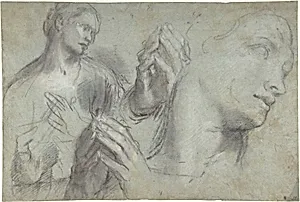
Medium
Black chalk, highlighted with white chalk and touches of red chalk, on blue-gray paper
Dimensions
11 x 16-1/4 in. (28 x 41.3 cm)
Classification
Drawings
Department
Drawings and Prints
Museum
Metropolitan Museum of Art, New York, NY
Credit
Rogers Fund, 1950
Accession Number
50.143
Rights
Public Domain
Tags
Art Historical Context
Federico Barocci (1526–1612), a leading Italian artist from Urbino, created this exquisite drawing, *Studies of a Man's and of His Hands*, 1592 and 1599. Working in the late Mannerist style with early Baroque tendencies, Barocci was renowned for his preparatory sketches that captured the tender humanity of his subjects. This sheet, measuring 11 x 16-1/4 inches, exemplifies his meticulous approach to anatomy, focusing on the expressive head and expressive hands of a male figurelikely studies for one of his religious compositions. Rendered in black chalk for subtle modeling, with white chalk highlights evoking soft light and delicate touches of red chalk for warmth, the drawing is set on blue-gray paper. This combination produces a luminous, almost sculptural effect, showcasing Barocci's innovative use of colored grounds to enhance three-dimensionality and emotional depth. Such techniques bridged Renaissance draftsmanship with the dramatic chiaroscuro of the coming Baroque era. Housed in the Metropolitan Museum of Art's Department of Drawings and Prints (acquired via the Rogers Fund in 1950), this work highlights Barocci's influence on later artists like Caravaggio through its intimate realism and psychological insight. Visitors will appreciate how these studies reveal the artist's empathetic eye for everyday gestures, turning observation into profound artistic poetry.
About the Artist
Federico Barocci · 1535–1612
Federico Barocci (c. 1535–1612) was an Italian painter from Urbino whose luminous, emotionally tender religious paintings made him one of the most original and influential artists of the late sixteenth century, bridging Mannerism and the early Baroque. Born in Urbino, the city of Raphael, he studied under Battista Franco and traveled to Rome, where he absorbed the lessons of Raphael, Correggio, an...