
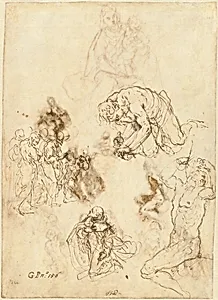
Studies of Christ Healing the Blind Man, Saint Philip Benizzi, and Saint Sebastian
c. 1611
Medium
pen and brown ink on cream laid paper
Dimensions
sheet: 35 x 24.9 cm (13 3/4 x 9 13/16 in.)
Classification
Drawing
Department
CG-E
Museum
National Gallery of Art, Washington, D.C.
Credit
Wolfgang Ratjen Collection, Patrons' Permanent Fund
Accession Number
2007.111.24.b
Rights
Public Domain
Art Historical Context
In the early 17th century, artist Jacopo Palma il Giovane (154–1628) created this captivating set of studies, dated around 1611. Executed in pen and brown ink on cream paper (35 x 24.9 cm), the drawing showcases three distinct religious subjects: Christ healing the blind man from the Gospel of Mark, Saint Philip Benizzia 13th-century Servite order founder known for miracles), and Saint Sebastian, arrow-pierced martyr symbolizing endurance. These preparatory sketches reflect Palma's role as a prolific church decorator in Venice, bridging late Mannerism and emerging Baroque dynamism. Palma, a pupil of Tintoretto and heir to Titian's legacy, favored fluid, expressive lines in ink to capture movement and emotion—techniques evident in the dramatic poses and intricate hatching here. Such studies were essential for his large-scale altarpieces and frescoes, allowing rapid exploration of compositions before committing to canvas or wall. Housed in the National Gallery of Art's Wolfgang Ratjen Collection, this work highlights the Renaissance valorization of disegno (drawing) as the foundation of art. It offers visitors a rare glimpse into an artist's creative process, revealing how sacred narratives were humanized through Venice's vibrant Catholic Counter-Reformation art.