
Studies van paarden
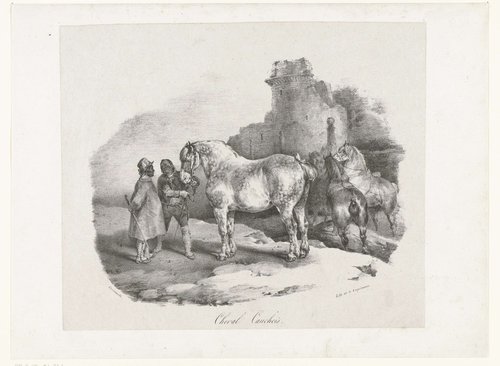
Medium
lithography
Dimensions
335; 250; 187; 226
Rights
Public Domain
About this artwork
height 187 mm x width 226 mm
Art Historical Context
Théodore Géricault's *Studies van paarden* ( of Horses), created in 1822, the artist's lifelong fascination with equine anatomy and movement. As a leading figure in French Romanticism, Géric was renowned for his dramatic, realistic portrayals of horses, seen earlier in masterpieces like *The Raft of Medusa* (1819). This modest lithograph, measuring just 187 mm high by 226 mm wide, exemplifies his shift toward printmaking in his final years, before his untimely death in 1824 at age 32. Lithography, a revolutionary technique Géricault helped pioneer in France, allowed for fluid, expressive lines drawn directly on stone with greasy crayon, then transferred to paper. Unlike engravings, it preserved the spontaneity of his sketches, making dynamic horse studies accessible beyond oil paintings. Produced during his time in England, where he absorbed influences from sporting art, this work reflects Romanticism's emphasis on raw energy and nature's power. For visitors, *Studies van paarden* offers a window into Géricault's meticulous preparation process—likely preliminary drawings for larger compositions. Its compact scale belies its significance as an early lithographic gem, bridging fine art and mass reproduction in 19th-century Europe.
About the Artist
Théodore Géricault · 1791–1824
Théodore Géricault (1791-1824) stands as one of the most influential pioneers of French Romanticism, despite a career tragically cut short at age thirty-two. Born in Rouen on September 26, 1791, into a wealthy family, Géricault's brief but intense artistic life transformed the trajectory of nineteenth-century European painting. Géricault began his formal training in 1808 under Carle Vernet, maste...