
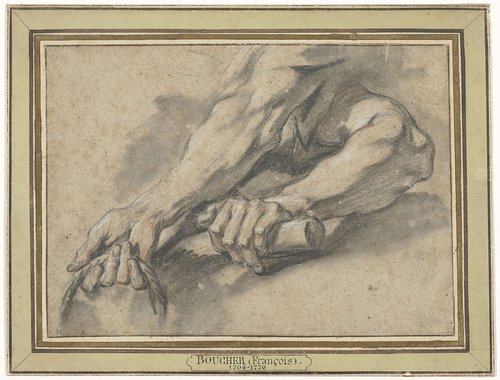
Studies van twee onderarmen
1713 - 1770
Medium
paper
Dimensions
162; 225
Rights
Public Domain
About this artwork
annotation, verso, upper centre, pencil: ‘Lesueu[r?]’
Art Historical Context
François Boucher, a central figure of the French Rococo movement, created this delicate drawing as part of his lifelong practice of studying the human form. Active from the early eighteenth century until his death in 1770, Boucher produced countless preparatory sketches that informed his celebrated paintings of mythological and pastoral scenes. The modest sheet, measuring just 162 by 225 millimeters on paper, captures two forearms with careful attention to muscle, bone, and subtle shading—evidence of the artist’s methodical approach to anatomy. Such studies were essential tools for painters of Boucher’s era, allowing them to master naturalistic poses before transferring them to larger canvases. The pencil annotation on the verso, reading “Lesueu[r?],” hints at earlier questions of attribution, reminding us how drawings often circulated and were reassessed long after an artist’s lifetime. Though small in scale, the work reveals Boucher’s graceful line and sensitivity to light, qualities that defined Rococo draftsmanship. Visitors can appreciate how even a fragment like this forearm study embodies the period’s emphasis on elegance, observation, and the quiet labor behind decorative splendor.
About the Artist
François Boucher · 1703–1770
François Boucher (1703–1770) stands as the quintessential master of French Rococo painting and the most celebrated decorative artist of the 18th century. Born in Paris to a lace designer, Boucher created a visual language that perfectly embodied the refined taste, sensuality, and elegance of Louis XV's court. His prolific output—encompassing paintings, tapestry designs, theatrical sets, and decora...