
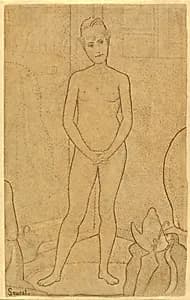
Study after "The Models"
1888
Medium
pen and brown ink over graphite on wove paper
Dimensions
overall: 26.4 x 16.1 cm (10 3/8 x 6 5/16 in.)
Classification
Drawing
Department
CG-E
Museum
National Gallery of Art, Washington, D.C.
Credit
The Armand Hammer Collection
Accession Number
1991.217.69
Rights
Public Domain
Art Historical Context
Georges Seurat created this delicate drawing in 1888 as a study after his ambitious painting *The Models*. A leading figure of the Neo-Impressionist movement, Seurat was renowned for his innovative Pointillist technique, which applied tiny dots of color to achieve luminous effects. This intimate work on paper offers a glimpse into his meticulous working process, revealing how he explored composition and form even in preparatory stages. Executed in pen and brown ink over graphite on wove paper, the drawing highlights Seurat’s command of line and subtle tonal gradation. Measuring just over 10 by 6 inches, its modest scale invites close looking, allowing viewers to appreciate the artist’s precise hand and thoughtful layering of media. Such studies underscore the importance of drawing in Seurat’s practice, serving as essential tools for refining the balanced, harmonious scenes that defined his major canvases. Housed in the National Gallery of Art as part of the Armand Hammer Collection, this piece enriches our understanding of late-19th-century artistic innovation. It reminds us that behind Seurat’s celebrated paintings lay countless hours of careful observation and experimentation on paper.
About the Artist
Georges Seurat · 1859–1891
Georges Seurat (1859-1891) was the founder of Neo-Impressionism and the inventor of Pointillism, a revolutionary technique that transformed how artists understand and apply color. In a tragically brief career cut short at age 31, Seurat produced only seven monumental paintings, yet his systematic application of color theory fundamentally altered the direction of modern art. Born in Paris to a pro...