
Study for a Massacre of the Innocents
1560–1636
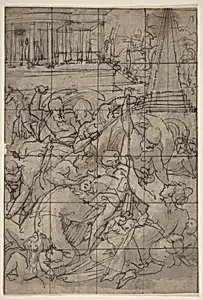
Medium
Black chalk, pen and bistre with gray-brown washes
Dimensions
sheet: 7 3/8 x 5 in. (18.7 x 12.7 cm)
Classification
Drawings
Department
Drawings and Prints
Museum
Metropolitan Museum of Art, New York, NY
Credit
Gift of Harry G. Friedman, 1957
Accession Number
57.658.281
Rights
Public Domain
Tags
Art Historical Context
Domenico Cresti, as Passignano (156–1636), was a prominent Florentine painter bridging the late Mannerist and early Baroque periods. This intimate drawing, *Study for a Massacre of Innocents*, captures the chaotic biblical tragedy from the Gospel of Matthew, where King Herod orders the slaughter of infant boys in Bethlehem to eliminate the infant Jesus. Created as a preparatory sketch, it exemplifies Passignano's skill in composing dynamic human figures amid violence, a theme popular in Renaissance and Baroque art to evoke emotional intensity during the Counter-Reformation era. Executed in black chalk, pen and bistre ink, with subtle gray-brown washes, the 7 3/8 x 5 in. sheet showcases virtuoso techniques for modeling form and shadow. These mixed media allowed artists like Passignano—trained under Giovan Battista Naldini and influenced by Cigoli—to rapidly explore poses, gestures, and dramatic lighting before committing to larger oil paintings or frescoes. The compact scale suggests it originated from a sketchbook, highlighting the spontaneity of Renaissance draftsmanship. Housed in the Metropolitan Museum of Art's Drawings and Prints department (gift of Harry G. Friedman, 1957), this work reveals the meticulous planning behind Passignano's grand altarpieces and offers visitors a window into the creative process of 17th-century Italian masters. Its raw energy in depicting human anguish underscores the enduring power of religious narratives in art.