
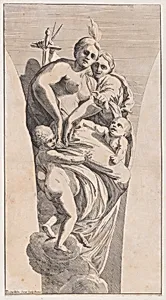
Study for a pendentive depicting Justice and Charity
Medium
Etching
Dimensions
sheet: 16 1/8 x 8 11/16 in. (41 x 22.1 cm)
Classification
Prints
Department
Drawings and Prints
Museum
Metropolitan Museum of Art, New York, NY
Credit
The Elisha Whittelsey Collection, The Elisha Whittelsey Fund, 1951
Accession Number
51.501.4255
Rights
Public Domain
Art Historical Context
This etching by Pietro Testa, possibly in collaboration with Giovanni Cesare Testa, served as a preparatory study for a pendentive—a curved triangular section supporting a dome—intended to feature the allegorical figures of Justice and Charity. Created between 1630 and 1650, the work reflects the Baroque period’s emphasis on grand architectural decoration, where such virtues were often celebrated in churches and civic spaces to inspire moral reflection among viewers. Rendered in the intricate lines of etching, a medium prized in 17th-century Italy for its ability to capture delicate shading and dynamic compositions, the print allowed artists to refine ideas before transferring them to fresco or sculpture. At roughly 16 by 9 inches, its elongated format suits the tapering shape of a pendentive, showcasing Testa’s skill in adapting classical themes to architectural demands. Acquired by the Metropolitan Museum through the Elisha Whittelsey Fund, this piece offers insight into the collaborative and iterative nature of Baroque design, where prints bridged the gap between initial sketches and monumental public art.
About the Artist
Pietro Testa|Giovanni Cesare Testa · 1612–1650
Pietro Testa was born in Lucca in 1612 and, in accordance with the conventions of Italian artistic training, made his way to Rome while still young. There he studied under two of the leading painters of the early seventeenth century: Domenichino, from whom he absorbed a taste for classical restraint and narrative clarity, and Pietro da Cortona, whose more exuberant Baroque manner offered a contras...