
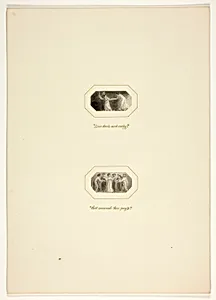
Study for a plate from The Triumphs of Temper, in the 1796 Royal Engagements Pocket Book
c. 1795
Medium
Ink wash on paper
Dimensions
2.5 × 5 cm (1 × 2 in.)
Classification
ink or chalk wash
Department
Prints and Drawings
Museum
Art Institute of Chicago
Accession Number
131240
Rights
Public Domain
Art Historical Context
Thomas Stothard (1755–1834), a leading British artist and Royal Academician, was renowned for his delicate illustrations blending neoclassical elegance with romantic narrative flair. This intimate *Study for a plate from The Triumphs of, in the 1796 Royal Engravings Pocket Book* (c. 1795) captures his skill in preparatory drawings. Created as a design for an engraving in a popular pocket-sized almanac, it draws from William Hayley's 1781 didactic poem celebrating emotional restraint, a theme resonant in late Enlightenment Britain amid social upheavals like the French Revolution. Executed in ink wash on paper—just 2.5 × 5 cm—this miniature work exemplifies the precision of monochrome wash technique, where diluted ink builds subtle tones and shadows for engraving translation. Stothard's fluid lines evoke poetic grace, likely depicting a tender scene from the poem's triumphs of temper over passion. Such studies highlight the collaborative artistry of the era, bridging fine art and commercial print culture. Housed in the Art Institute of Chicago's Prints and Drawings Department, this piece offers a window into 18th-century book illustration's boom, when pocket books like the *Royal Engravings* made high art accessible to everyday readers. Its tiny scale underscores Stothard's mastery of intimacy, inviting close contemplation of virtue's quiet victories.
About the Artist
Thomas Stothard · 1755–1834
Thomas Stothard RA (1755–1834) was born on 17 August 1755 at the Black Horse Inn in London's Long Acre, the son of a prosperous publican originally from Stutton near Tadcaster. A delicate child, he was sent at age five to relatives in Yorkshire, attending schools in Acomb, Tadcaster, and later Ilford, Essex, where he honed his drawing skills by copying prints. Following his father's death in 1770,...