
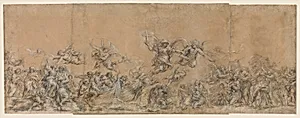
Study for Angels Sealing the Foreheads of the Children of Israel in Saint Peter's Basilica
Medium
Black chalk, brush with brown and gray wash, highlighted with white gouache, on three sheets of brownish paper glued with overlapping joints
Dimensions
16-3/4 x 44-9/16 in. (42.7 x 113.2 cm) maximum, unevenly cut upper and lower borders
Classification
Drawings
Department
Drawings and Prints
Museum
Metropolitan Museum of Art, New York, NY
Credit
Rogers Fund, 1966
Accession Number
66.134.1a–c
Rights
Public Domain
Tags
Art Historical Context
Pietro da Cortona, master of the Roman Baroque, created this monumental drawing in 1652 as a study for a fresco in Saint Peter's Basilica. Titled *Study for Angels Sealing Foreheads of the Children Israel*, it depicts a biblical scene inspired by Ezekiel 9, where angels the foreheads of the faithful amid chaos. Cortona's dynamic composition captures swirling figures—men, women, children, and angels—along with boats, evoking divine intervention and salvation in a vast, theatrical space befitting the Vatican's grandeur. Executed on three sheets of brownish paper glued together, the work measures an impressive 16-3/4 x 44-9/16 inches, its uneven borders hinting at the artist's on-the-spot adjustments. Cortona employed black chalk for precise contours, brush with brown and gray wash for modeling depth, and white gouache highlights to simulate the luminous effects of fresco. This mixed-media technique was essential for planning large-scale ceiling decorations, allowing Cortona to test light, movement, and foreshortening before committing to wet plaster. As a rare surviving study from one of Baroque Rome's most ambitious projects, it showcases Cortona's innovative fusion of Michelangelo's monumentality with illusionistic drama, influencing generations of ceiling painters. Acquired by The Metropolitan Museum of Art via the Rogers Fund in 1966, it offers visitors a window into the meticulous craft behind St. Peter's eternal splendor.
About the Artist
Pietro da Cortona (Pietro Berrettini) · 1596–1669
Pietro da Cortona, born Pietro Berrettini on November 1, 1596, in the Tuscan hill town of Cortona, emerged as one of the towering figures of Italian Baroque art, excelling as a painter, architect, and decorator. He received his early training under the Florentine painters Andrea Commodi and Baccio Ciarpi. In 1612, Commodi brought the young artist to Rome, where Pietro immersed himself in the city'...