
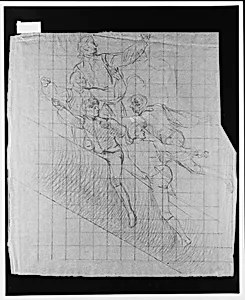
Study for "The Siege of Gibraltar": Figures Astride Spar
1785–86
Medium
Black and red chalk and white-chalk heightening on dark blue laid paper
Dimensions
22 5/8 x 18 3/8 in. (57.5 x 46.7 cm)
Classification
Drawing
Culture
American
Department
The American Wing
Museum
Metropolitan Museum of Art, New York, NY
Credit
Purchase, Louisa Eldridge McBurney Gift, 1960
Accession Number
60.44.13
Rights
Public Domain
Tags
Art Historical Context
John Singleton Copley, pioneering American artist who later thrived in London, created this dynamic preparatory drawing around 1785–86 as part of his ambitious series on *The Siege of Gibraltar*. pivotal event (1779–83) during the American Revolutionary War era saw British forces heroically the Rock of Gibraltar against Spanish and French assaults, a triumph Copley immortalized in massive history paintings now celebrated for their dramatic realism and patriotic fervor. Here, figures astride a spar—likely sailors or soldiers—capture the perilous intensity of naval combat, showcasing Copley's neoclassical style blending meticulous detail with theatrical energy. Rendered in black and red chalk with white-chalk heightening on dark blue laid paper (22 5/8 x 18 3/8 in.), the work exemplifies 18th-century draftsmanship techniques. The tinted paper provides a moody mid-tone, allowing chalks to sculpt form through shadow, contour, and luminous highlights, evoking the chaos of battle under stormy skies. Such studies reveal Copley's methodical process, refining compositions for his grand oils and bridging portraiture's precision with history painting's epic scale. Housed in The Metropolitan Museum of Art's American Wing (Purchase, Louisa Eldridge McBurney Gift, 1960), this piece highlights Copley's transatlantic legacy, inviting visitors to appreciate how a Boston-born talent shaped British art while honoring colonial-era heroism.
About the Artist
John Singleton Copley · 1738–1815
John Singleton Copley (1738–1815) was the greatest American painter of the colonial era and one of the finest portraitists in the English-speaking world. Born in Boston, Massachusetts, he was largely self-taught, learning from mezzotint reproductions of European paintings and from his stepfather Peter Pelham, an engraver. By his early twenties, Copley had established himself as Boston's leading po...