
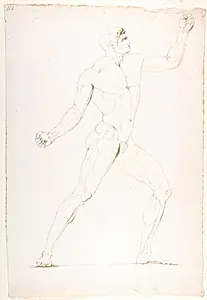
Study of a Nude Man in Profile turned to the Right
n.d.
Medium
Pen and brown ink over graphite
Dimensions
sheet: 19 1/8 x 12 15/16 in. (48.6 x 32.8 cm)
Classification
Drawings
Department
Drawings and Prints
Museum
Metropolitan Museum of Art, New York, NY
Credit
Purchase, Guy Wildenstein and Sally and Howard Lepow Gifts, 2008
Accession Number
2008.526
Rights
Public Domain
Tags
Art Historical Context
Antonio Canova, the preeminent neoclassical sculptor of late 18th and 19th centuries, this exquisite *Study of a Nude Man in Profile turned to the* using pen and brown ink over graphite on a generous sheet measuring 19 1/8 x 12 15/16 inches. Undated, this drawing exemplifies Canova's meticulous preparatory process, where fluid graphite sketches underpin precise ink lines to capture the male figure's idealized anatomy and graceful profile. His neoclassical style drew inspiration from ancient Greek and Roman art, emphasizing harmony, proportion, and the heroic nude as a symbol of beauty and virtue. Such studies were essential to Canova's workflow, serving as anatomical explorations before translating forms into marble masterpieces like *Psyche Revived by Cupid's Kiss*. The profile view highlights his mastery of contour and torsion, allowing visitors to appreciate the sculptor's eye for three-dimensionality on a flat surface. Brown ink's warm tone adds depth, evoking the classical contrapposto pose. Acquired by the Metropolitan Museum of Art in 2008 through generous gifts, this work invites us into Canova's studio, bridging the gap between sketch and sculpture. It reminds us how neoclassicism revived antiquity's ideals amid Enlightenment ideals, making the human form a timeless pursuit of perfection.
About the Artist
Antonio Canova · 1757–1822
Antonio Canova, born on November 1, 1757, in the small town of Possagno in the Republic of Venice, was immersed in sculpture from childhood. His father, Pietro Canova, a stonecutter, died when Antonio was just four, prompting his mother, Angela Zardo Fantolin, to remarry and place him under the care of his paternal grandfather, Pasino Canova. A skilled stonemason and sculptor of late Baroque altar...