
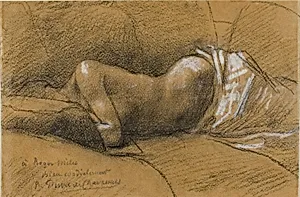
Study of a Sleeping Woman
c. 1867
Medium
Black Conté crayon, heightened with white pastel, on tan wove paper, laid down on cream card
Dimensions
15 × 23 cm (5 15/16 × 9 1/16 in.)
Classification
paper
Department
Prints and Drawings
Museum
Art Institute of Chicago
Accession Number
192874
Rights
Public Domain
Art Historical Context
In the tranquil "Study of a Sleeping Woman," created around 1867 by French artist Pierre Puvis de Chavannes, we glimpse the dreamlike introspection that defined his career. Puvis, a pioneer of Symbolism, blended classical idealism with poetic reverie in his murals and paintings, often exploring themes of rest, myth, and human serenity. This intimate preparatory drawing captures a reclining figure in soft repose, her form emerging from shadow into gentle light—a hallmark of his ethereal style. Executed on tan wove paper with black Conté crayon for deep, velvety tones and heightened with white pastel for luminous highlights, the work showcases Puvis's masterful draftsmanship. At just 15 × 23 cm, its modest scale belies the technical sophistication: the mid-toned paper serves as a natural base, allowing the artist to model volume efficiently. Laid down on cream card for preservation, it reflects 19th-century connoisseurship of drawings as autonomous artworks. Housed in the Art Institute of Chicago's Prints and Drawings department, this study offers a window into Puvis's creative process during a pivotal era, as he transitioned from academic training to monumental public commissions. For visitors, it's a serene invitation to ponder the quiet beauty of sleep amid the Symbolist pursuit of the soul's hidden depths.
About the Artist
Pierre Puvis de Chavannes · 1824–1898
Pierre Puvis de Chavannes (1824–1898) was a French painter who became the foremost muralist of nineteenth-century France and a crucial bridge between academic tradition and modernism. Born in Lyon to a prosperous family, he studied briefly with Henri Scheffer and Thomas Couture in Paris and traveled to Italy, where the frescoes of the Italian Renaissance made a lasting impression on his artistic v...