
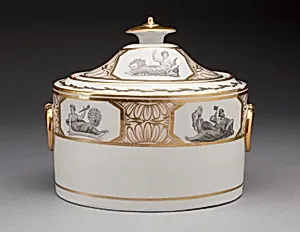
Sugar Bowl with Cover
c. 1800
Medium
Soft-paste porcelain with monochrome gray and gilding
Dimensions
12.1 × 14.9 cm (4 3/4 × 5 7/8 in.); Diam.: 14.9 cm (5 7/8 in.)
Classification
sugar bowl
Department
Applied Arts of Europe
Museum
Art Institute of Chicago
Accession Number
66706
Rights
Public Domain
Art Historical Context
This elegant sugar bowl with cover, crafted by the renowned Worcester Porcelain Factory around 1800, exemplifies the refined tableware of late Georgian England. Measuring just 12.1 × 14.9 cm with a 14.9 cm diameter, was designed for domestic use, likely as part of a tea or coffee service. The factory, established in 1751, was a powerhouse of British porcelain production, rivaling continental makers like Meissen and Svres, and this piece reflects its mastery during a transitional era. Made from soft-paste porcelain—a glassy, translucent material blending clay with ground frit—this bowl features a sophisticated monochrome gray palette accented by gilding. Soft-paste, prized for its delicate sheen before bone china dominated, allowed for intricate molding and firing techniques that captured subtle light play. The restrained grisaille decoration and gold highlights evoke Neoclassical tastes, emphasizing luxury through simplicity amid Britain's booming sugar trade from colonial plantations. Housed in the Art Institute of Chicago's Department of Applied Arts of Europe, this sugar bowl offers a glimpse into everyday opulence, where functional objects became status symbols. Visitors can appreciate how Worcester's innovations made fine porcelain accessible to the growing middle class, blending artistry with cultural rituals of hospitality.
About the Artist
Worcester Porcelain Factory · 1751–1783
**Worcester Porcelain Factory (1751–1783)** The Worcester Porcelain Factory, often called the Dr. Wall Period, was established in 1751 in Worcester, England, by physician Dr. John Wall and apothecary William Davis, who rallied 13 local businessmen to invest £4,500. Site at Warmstry House on the River Severn, the "Worcester Tonquin Manufactory" produced soft-paste porcelain using a steatite (soapr...