
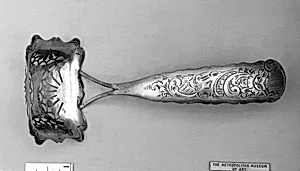
Sugar sifter
Unknown Artist
19th century
Medium
Silver
Dimensions
Length: 5 3/8 in. (13.7 cm)
Classification
Metalwork-Silver
Culture
Dutch
Department
European Sculpture and Decorative Arts
Museum
Metropolitan Museum of Art, New York, NY
Credit
Gift of Mrs. Samuel P. Avery, 1897
Accession Number
97.2.37
Rights
Public Domain
Art Historical Context
Step into the elegant world of 19th-century Dutch with this delicate *Sugar Sifter*, a exquisite example of everyday luxury crafted in silver. Measuring just 5 3/8 inches (13.7 cm) in length, this small metalwork tool was designed for sprinkling fine sugar over desserts, tea, or coffee—a refined ritual that highlighted the owner's affluence, as refined sugar remained a costly import even into the 1800s. Hailing from Dutch culture, the sifter reflects the Netherlands' longstanding tradition of masterful silversmithing, where artisans excelled in creating functional yet beautifully wrought objects. Silver's luster and durability made it ideal for tableware, often featuring subtle chasing or piercing techniques to allow sugar to sift evenly. Though the artist remains unknown, such pieces embodied the period's blend of practicality and understated opulence, bridging the opulent Dutch Golden Age with 19th-century neoclassical restraint. A generous gift to the Metropolitan Museum of Art from Mrs. Samuel P. Avery in 1897, this sifter now graces the European Sculpture and Decorative Arts department. It invites us to savor the sensory pleasures of bygone eras, where even a simple utensil sparkled with cultural sophistication.