
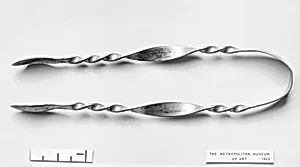
Sugar tongs
Unknown Artist
ca. 1770–90
Medium
Sheffield plate
Dimensions
Length: 4 7/8 in. (12.4 cm)
Classification
Metalwork-Silverplate
Culture
British
Department
European Sculpture and Decorative Arts
Museum
Metropolitan Museum of Art, New York, NY
Credit
Gift of Mrs. Julia W. Torrey, 1922
Accession Number
22.23.8
Rights
Public Domain
Art Historical Context
Step into the refined world of 18th-century British tea culture with these delicate sugar tongs, crafted around 1770–90. Measuring just 4 7/8 inches long, this petite metalwork piece from the Metropolitan Museum of Art's European Sculpture and Decorative collection exemplifies everyday elegance. Donated in 1922 by Mrs. Julia W. Torrey, it hails from Sheffield, England, a hub of innovative metalworking. Made in Sheffield plate—a groundbreaking technique fusing a thin layer of silver to a copper base—these tongs highlight a pivotal advancement in decorative arts. Invented in the 1740s by Thomas Boulsover, Sheffield plate offered the luster of sterling silver at a fraction of the cost, making luxurious tableware accessible to the growing middle class. By the late Georgian era, such items were staples in fashionable households, reflecting Britain's booming trade in tea, sugar, and porcelain. Sugar tongs like these were essential for serving lump sugar during afternoon tea rituals, a social custom that symbolized refinement and hospitality. Though the artist remains unknown, the tongs embody the period's neoclassical simplicity and craftsmanship, bridging utility and artistry in British domestic life. A charming glimpse into how everyday objects carried cultural weight!