
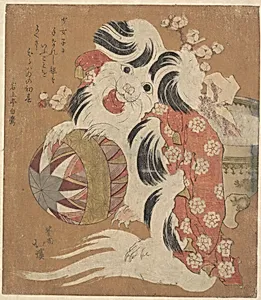
Surimono Calendar for the Dog Year, 1814
1814
Medium
Woodblock print (surimono); ink and color on paper
Dimensions
8 1/16 x 7 in. (20.5 x 17.8 cm)
Classification
Prints
Culture & Period
Japan · Edo period (1615–1868)
Department
Asian Art
Museum
Metropolitan Museum of Art, New York, NY
Credit
Gift of Estate of Samuel Isham, 1914
Accession Number
JP1032
Rights
Public Domain
Tags
Art Historical Context
This woodblock print presents a lively white dog with black markings and a cheerful expression, its mouth open as if barking or laughing. Dressed in a red kimono decorated with white blossoms, the dog playfully rests one paw on a large, patterned ball while cherry blossoms bloom in the background. Delicate lines and soft washes of color define the fur, fabric, and floral details, with Japanese text elegantly arranged along the left side of the composition. Created by Totoya Hokkei in 1814, this surimono celebrates the Year of the Dog. Surimono were privately commissioned woodblock prints that often combined images with poetry or calendars, reflecting the refined tastes of Edo-period collectors. Hokkei, known for his graceful and imaginative designs, produced this work in ink and color on paper as a seasonal greeting that blends humor with seasonal symbolism.
About the Artist
Totoya Hokkei · 1780–1850
Totoya Hokkei (魚屋 北渓, 1780–1850), born Iwakubo Tatsuyuki in Edo (modern Tokyo), began his life as a humble fishmonger in the Yotsuya Samegahashi district, a trade reflected in his art name "Totoya," meaning fish shop. He transitioned to art through rigorous training, first studying under Kanō Yōsen'in Korenobu, head of the Kobikichō branch of the prestigious Kanō school, where he honed landscape p...