
Swingling Stick
Unknown Artist
1700–1800
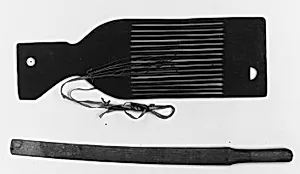
Medium
Wood
Dimensions
H. 29 in. (73.7 cm)
Classification
Swinging stick
Department
The American Wing
Museum
Metropolitan Museum of Art, New York, NY
Credit
Gift of Mrs. Russell Sage, 1909
Accession Number
10.125.666 D
Rights
Public Domain
Art Historical Context
Nestled in The Metropolitan Museum of Art's Wing, the *Swingling Stick* (ca. 1700–1800) is a humble yet vital wooden tool from colonial America. Crafted from wood and standing 29 inches tall, this anonymous artifact exemplifies the everyday ingenuity of early settlers. Donated by Mrs. Russell Sage in 9, it offers a tangible link to the pre-industrial era when households produced their own textiles. A swingle, or swingling stick, was essential in flax processing—a labor-intensive step toward making linen cloth. After retting in water to soften the stalks, the tool's flat, blade-like end was swung forcefully against a block to break away the brittle outer hurds, revealing fine fibers for spinning. Hand-shaped from a single piece of wood, its ergonomic form reflects practical craftsmanship, blending utility with subtle folk artistry in an age of self-reliance. Displayed today, this unadorned implement highlights the cultural backbone of 18th-century American life: domestic industry and resourcefulness. In a time before factories, such tools empowered families to transform humble plants into clothing and household goods, underscoring the rhythm of rural labor and the roots of American material culture.