
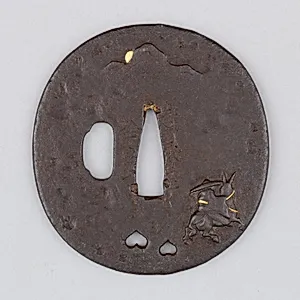
Sword Guard (Tsuba)
Unknown Artist
18th century
Medium
Iron, gold, copper
Dimensions
H. 3 1/16 in. (7.8 cm); W. 2 7/8 in. (7.3 cm); thickness 1/4 in. (0.6 cm); Wt. 3.6 oz. (102.1 g)
Classification
Sword Furniture-Tsuba
Culture
Japanese
Department
Arms and Armor
Museum
Metropolitan Museum of Art, New York, NY
Credit
The Howard Mansfield Collection, Gift of Howard Mansfield, 1936
Accession Number
36.120.46
Rights
Public Domain
Tags
Art Historical Context
This exquisite 18th-century Japanese guard, or *tsuba*, served as a protective handguard on samurai swords, blending functionality with artistry during the Edo period (1603–1868). Crafted from iron inlaid with gold and copper it exemplifies the refined metalworking traditions of Japan's arms and armor makers. Measuring just 3 1/16 inches high weighing a substantial 3.6 ounces, its compact form was designed for balance and quick draw, while allowing the wielder's fingers to pass through. The openwork design features lively scenes of human figures and donkeys, capturing everyday rural life or perhaps a folk tale motif symbolizing humility and endurance—common themes in Japanese decorative arts. Techniques like *zōgan* (metal inlay) highlight the artisan's skill, where softer gold and copper were hammered into precise cuts in the hardened iron, creating shimmering contrasts that catch the light. Part of The Howard Mansfield Collection gifted to the Metropolitan Museum of Art in 1936, this *tsuba* reflects the status of sword fittings as coveted collector's items among the elite. Beyond the battlefield, it invites us to appreciate Japan's fusion of utility and beauty in everyday objects turned treasures.