
Sword Guard (Tsuba)
Unknown Artist
18th century
Medium
Iron, copper
Dimensions
H. 2 7/8 in. (7.3 cm); W. 2 7/8 in. (7.3 cm); thickness 1/4 in. (0.6 cm); Wt. 4.2 oz. (119.1 g)
Classification
Sword Furniture-Tsuba
Culture
Japanese
Department
Arms and Armor
Museum
Metropolitan Museum of Art, New York, NY
Credit
The Howard Mansfield Collection, Gift of Howard Mansfield, 1936
Accession Number
36.120.59
Rights
Public Domain
Tags
Art Historical Context
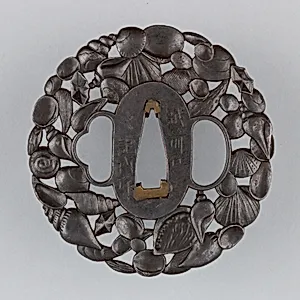
This exquisite **Sword Guard (Tsuba)** from 18th-century Japan exemplifies the masterful fusion of function and artistry in samurai weaponry. Crafted from iron with copper accents, this nearly circular guard measures just 2⅞ inches (7.3 cm) in height and width, with a sturdy ¼-inch (0.6 cm) thickness and a weight of 4.2 ounces (119.1 g). Its design features intricate motifs of shells, likely rendered through piercing openwork (anagami) or delicate inlays (zougan), techniques that allowed artisans to transform a protective hand guard into a miniature sculptural masterpiece. During Japan's Edo period (1603–1868), tsuba evolved from mere utility into symbols of refinement and status among the warrior class. Positioned at the base of the sword hilt, it shielded the hand while showcasing the owner's taste through nature-inspired themes like shells, which evoked the sea's beauty and perhaps auspicious symbolism of prosperity or resilience. Unsigned works like this one highlight the skill of anonymous Goto-school or similar craftsmen, who hammered and patinated iron for a rich, enduring surface. Now part of The Howard Mansfield Collection at The Metropolitan Museum of Art (gift of 1936), this tsuba invites visitors to appreciate how everyday armor became high art, bridging utility, aesthetics, and cultural heritage in feudal Japan.