
Sword Guard (Tsuba)
Unknown Artist
end of 17th century
Medium
Silver, gold
Dimensions
W. 3 3/8 in. (8.6 cm)
Classification
Sword Furniture-Tsuba
Culture
Japanese
Department
Arms and Armor
Museum
Metropolitan Museum of Art, New York, NY
Credit
Rogers Fund, 1932
Accession Number
32.85.1
Rights
Public Domain
Tags
About this artwork
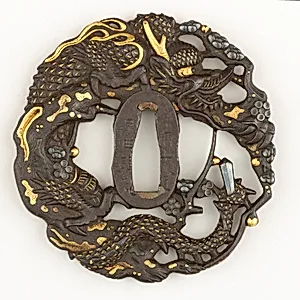
This elegant sword guard exemplifies the sophisticated metalworking traditions of late 17th-century Japan, when the tsuba evolved from purely functional armor into refined works of decorative art. Crafted in silver and gold at the end of the Edo period's first century, this piece demonstrates the technical mastery and aesthetic refinement that characterized Japanese sword furniture. As Japan entered a long period of relative peace under Tokugawa rule, sword guards increasingly served ornamental ...
Art Historical Context
This elegant silver and gold sword guard, or *tsuba*, hails from late 17th-century Japan, during early Edo period under Tokugawa rule—a time of relative peace that transformed samurai swords from battlefield tools into symbols of status and artistry. Originally functional guards protecting the hand, *tsuba* like this one evolved into exquisite decorative objects, showcasing the era's masterful metalworking. Measuring about 3⅜ inches wide, it fits the standard for *katana* swords and was likely commissioned for a patron, reflecting personal taste through motifs such as dragons, which symbolized power and imperial authority in Japanese culture. Crafted with sophisticated techniques like inlay, overlay, and metal-coloring, the piece highlights the virtuoso skill of anonymous artisans who rendered intricate designs on a modest scale. Gold accents against silver create a luxurious contrast, turning military gear into wearable art that conveyed the owner's education, heritage, or literary interests. As Japan enjoyed centuries of stability, *tsuba* became collectible treasures, bridging utility and beauty. Acquired through the Rogers Fund in 1932, this *tsuba* at the Metropolitan Museum of Art exemplifies how peace fostered innovation in Japanese arms and armor, inviting us to appreciate the delicate balance of form, function, and symbolism in everyday samurai elegance.