
Sword Guard (Tsuba)
Unknown Artist
17th–18th century
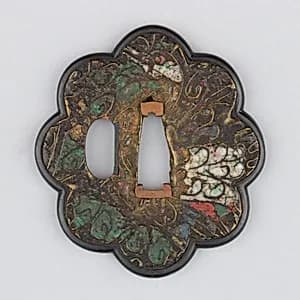
Medium
Copper, enameled cloisonné (shippō), copper-gold alloy (shakudō)
Dimensions
H. 2 3/4 in. (7 cm); W. 2 1/2 in. (6.4 cm); thickness 3/16 in. (0.5 cm); Wt. 3.1 oz. (87.9 g)
Classification
Sword Furniture-Tsuba
Culture
Japanese
Department
Arms and Armor
Museum
Metropolitan Museum of Art, New York, NY
Credit
Bequest of Edward G. Kennedy, 1932
Accession Number
33.40.49
Rights
Public Domain
Art Historical Context
This exquisite sword guard, or *tsuba*, hails from Japan's Edo period (17th–18th century), a time of relative peace when samurai swords evolved from battlefield weapons into symbols of status and artistry. Crafted for the katana, the *tsuba* served a practical purpose—shielding the hand from an opponent's blade—while doubling as a canvas for intricate decoration. Measuring just 2¾ inches high, this copper piece exemplifies the refined metalworking traditions of Japanese sword fittings, now housed in the Metropolitan Museum of Art's Arms and Armor department thanks to the 1932 bequest of Edward G. Kennedy. The artwork shines through its masterful use of *shippō* (cloisonné enamel) and *shakudō* (a copper-gold alloy). Fine wires are soldered onto the copper base to form delicate cells, which are filled with vibrant enamels and repeatedly fired to create luminous, jewel-like patterns. Shakudō adds a luxurious depth, often patinated to a rich black for contrasting motifs. These techniques highlight the pinnacle of Japanese *kinko* (metalworking) artistry, where functionality met opulent beauty. Culturally, *tsuba* like this one reflected the wearer's taste and social standing, blending Zen simplicity with exuberant detail. Though the artist remains unknown, such guards were prized by collectors worldwide, bridging the worlds of warfare and aesthetics in feudal Japan.