
BK-1981-88
1736
Medium
damask
Dimensions
210; 343
Rights
Public Domain
About this artwork
hoogte 343 cm x breedte 210 cm
Art Historical Context
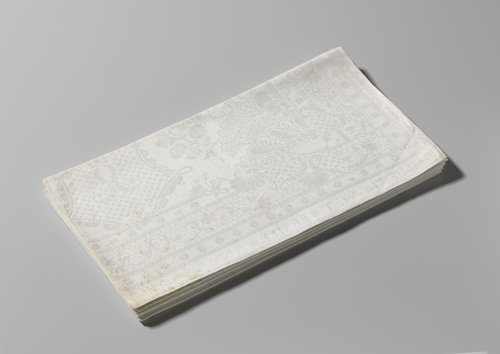
This magnificent damask textile, cataloged as BK-1981-88 and dated 1736, as a testament to the opulence of 18th European interiors. Measuring approximately 343 cm in height by 210 cm in width, its grand scale suggests it was designed for use as a lavish curtain, bed hanging, or wall panel in a prosperous household. Crafted anonymously by skilled weavers, likely in a European workshop, it exemplifies the era's fascination with luxurious fabrics that transformed spaces into statements of wealth and refinement. Damask, a sophisticated woven silk fabric, derives its name from the city of Damascus, though by the 1730s, production thrived in centers like Lyon, France, and the Dutch Republic. The technique involves reversible patterns created through contrasting satin and sateen weaves, often featuring intricate floral, architectural, or baroque motifs that shimmer with light. In the early Rococo period, such textiles were prized for their tactile elegance and ability to catch candlelight, symbolizing status amid the Enlightenment's blend of luxury and emerging neoclassicism. Though the artist's identity remains unknown, this piece highlights the collaborative artistry of textile workshops, where designers and looms worked in harmony. Today, it invites us to envision the candlelit salons of 1736, where every fold whispered tales of trade, craftsmanship, and cultural splendor.
About the Artist
anonymous
In the vast tapestry of art history, "Anonymous" stands not as a singular individual but as a collective designation for countless unidentified creators whose works have endured across millennia. These artists, spanning prehistoric cave painters to medieval illuminators and folk craftsmen, produced the foundational layers of human visual culture. Prior to the Renaissance, when individual fame emer...