
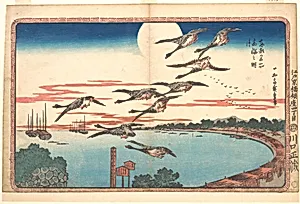
Takanawa no Meigetsu|東都名所 高輪之明月|Full Moon at Takanawa
ca. 1831
Medium
Woodblock print; ink and color on paper
Dimensions
H. 9 5/8 in. (24.4 cm); W. 15 1/8 in. (38.4 cm)
Classification
Prints
Culture & Period
Japan · Edo period (1615–1868)
Department
Asian Art
Museum
Metropolitan Museum of Art, New York, NY
Credit
Rogers Fund, 1922
Accession Number
JP1313
Rights
Public Domain
Tags
Art Historical Context
**Full Moon at Takanawa (Takanawa no Meigetsu)** From Utagawa Hirosh's early series *Eastern Capital Famous Places* (ōto Meisho), created around 1831, this woodblock print captures poetic nocturnal scene at Takanawa, a coastal area near Edo (modern Tokyo). During Japan's Edo period (16151868), such *ukiyo-e* prints celebrated the "floating world" of everyday beauty, blending urban life with nature. Hiroshige, a master of landscape depiction, masterfully conveys the serene glow of the full moon illuminating boats on the water and birds in flight, evoking the Japanese tradition of *tsukimi*—moon viewing—as a cherished autumn pastime. The *ōban* format (approximately 9⅝ × 15⅛ inches) allowed for expansive compositions, with vibrant inks and colors layered through the intricate woodblock process. Artisans carved separate blocks for each hue, achieving subtle gradients in the moonlit sky and rippling waves that draw the eye into the tranquil bay. This technique not only democratized art—prints were affordable for commoners—but also highlighted Hiroshige's genius for atmospheric perspective, foreshadowing his later masterpieces like *The Fifty-three Stations of the Tōkaidō*. Housed in the Metropolitan Museum of Art's Asian Art collection (Rogers Fund, 1922), this print exemplifies ukiyo-e's global influence, inspiring Western artists like Vincent van Gogh. It invites visitors to ponder the timeless allure of nature's quiet majesty amid bustling city life.
About the Artist
Utagawa Hiroshige · 1826–1869
Utagawa Hiroshige (1797–1858), born Andō Tokutarō, was the last great master of Japanese ukiyo-e woodblock printmaking and one of the most influential landscape artists in history. Born in Edo (modern Tokyo) into a low-ranking samurai family serving as fire wardens, Hiroshige transformed landscape printmaking into a poetic meditation on nature, weather, and everyday life. His revolutionary approac...