
Talismanic Scroll
Unknown Artist
11th century
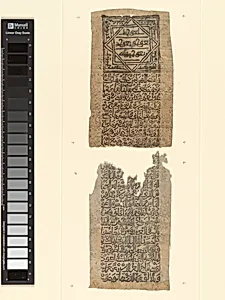
Medium
Ink on paper; block printed
Dimensions
H. 10 7/8 in. (27.61 cm) W. 3 1/8 in. (7.9 cm)
Classification
Codices
Department
Islamic Art
Museum
Metropolitan Museum of Art, New York, NY
Credit
Gift of Nelly, Violet and Elie Abemayor, in memory of Michel Abemayor, 1978
Accession Number
1978.546.36
Rights
Public Domain
Tags
Art Historical Context
Nestled in the Islamic Art collection of the Metropolitan Museum of Art, this *Talismanic Scroll* from the 11th century is a testament to medieval spiritual practices. Crafted by an unknown artist, the narrow scroll—measuring just 10 7/8 by 3 1/8 inches—fits easily in the hand, suggesting it was designed as a portable amulet. Gifted in 1978 by the Abemayor family in of Michel Abemay, it exemplifies the codex classification while embodying the scroll format, a bridge between ancient manuscript traditions and protective artifacts. What stands out is its pioneering medium: ink on paper, block printed. Block printing, an early reproductive technique in the Islamic world, allowed for the efficient creation of sacred texts and symbols. Likely adorned with Quranic verses, invocations, or mystical diagrams, such scrolls were believed to ward off evil, illness, or misfortune, reflecting the era's blend of faith, magic, and artistry amid the flourishing Abbasid or Fatimid caliphates. This unassuming treasure invites us to ponder the intimate role of art in daily life, where a slip of paper became a shield for the soul. Its survival highlights the enduring allure of Islamic talismanic traditions, bridging the mystical past with our curiosity today.