
Tapestry Fragment
Unknown Artist
10th–15th century
Medium
Camelid hair
Dimensions
Overall: 6 1/4 x 14 1/4 in. (15.88 x 36.2 cm) Other: 6 1/4 in. (15.88 cm)
Classification
Textiles-Woven
Culture
Peru; central coast (?)
Department
Arts of Africa, Oceania, and the Americas
Museum
Metropolitan Museum of Art, New York, NY
Credit
Rogers Fund, 1909
Accession Number
09.50.2129
Rights
Public Domain
Art Historical Context
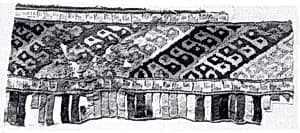
This exquisite **Tapestry Fragment**, woven from camelid hair—likely alpaca or llama fiber—hails from Peru's central coast, dating to the 10th–15th. Measuring just 6¼ x 14¼ inches, this small yet masterful piece exemplifies the pinnacle of pre-Columbian textile artistry. Acquired through the Rogers Fund in 1909, it now resides in the Metropolitan of Art's Department of Arts of Africa,, and the Americas, a glimpse into a vibrant cultural tradition. Crafted using the intricate tapestry weave technique, where colored weft threads interlock to create vivid patterns without slits, the fragment showcases the technical virtuosity of ancient Peruvian weavers. Camelid hair provided exceptional durability, softness, and dye affinity, allowing for rich hues that symbolized status and cosmology. During this era, spanning regional cultures like the Chimú or Chancay through early Inca influence, textiles were more than fabric—they served as currency, elite garments, and ritual offerings, often buried with the dead to accompany souls in the afterlife. Though details of its exact design remain subtle in this fragment, it reflects the Andes' legacy of woven storytelling, where motifs of animals, deities, and geometric forms encoded spiritual beliefs. A testament to anonymous mastery, it invites us to marvel at the ingenuity of Peru's ancient artisans.