
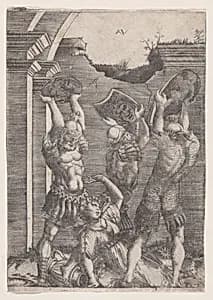
Tarpeia Crushed by the Sabines
ca. 1514–36
Medium
Engraving
Dimensions
5 3/16 x 3 9/16 in. (13.1 x 9.0 cm)
Classification
Prints
Department
Drawings and Prints
Museum
Metropolitan Museum of Art, New York, NY
Credit
Purchase, Joseph Pulitzer Bequest, 1917
Accession Number
17.50.16-76
Rights
Public Domain
Art Historical Context
Agostino Veneziano’s engraving “Tarpeia Crushed by the Sabines” captures a dramatic episode from early Roman legend. According to the story, the Roman maiden Tarpeia betrayed the city to the invading Sabines in exchange for what they wore on their left arms—only to be crushed beneath their heavy shields. Working in the first half of the sixteenth century, Veneziano (also known as Agostino dei Musi) was among the leading reproductive engravers of the Italian Renaissance, translating paintings and designs by masters such as Raphael into finely detailed prints. The medium itself is significant: engraving allowed intricate line work and tonal shading to be reproduced in multiple impressions, spreading classical narratives far beyond the walls of palaces and churches. Though modest in size—just over five by three inches—this print demonstrates Veneziano’s command of dramatic composition and expressive gesture within a compact format. Acquired by the Metropolitan Museum in 1917, it remains a vivid example of how Renaissance printmakers helped keep ancient myths alive for new generations.