
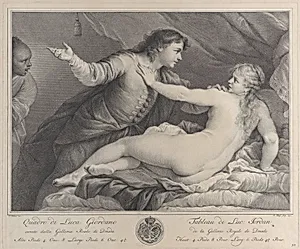
Tarquin and Lucretia
Medium
Etching and engraving
Dimensions
Plate: 14 × 16 7/8 in. (35.5 × 42.9 cm) Sheet: 15 3/4 × 20 11/16 in. (40 × 52.6 cm)
Classification
Prints
Department
Drawings and Prints
Museum
Metropolitan Museum of Art, New York, NY
Credit
Gift of Georgiana W. Sargent, in memory of John Osborne Sargent, 1924
Accession Number
24.63.1434
Rights
Public Domain
Art Historical Context
This striking print captures the dramatic climax of the ancient Roman legend of Tarquin and Lucretia, a story that has long symbolized the consequences of tyranny and the defense of honor. Created in 1752 through the combined techniques of etching and engraving, the work translates the dynamic composition of Baroque painter Luca Giordano into a reproducible format. The collaborative efforts of Charles Hutin and Pieter Tanjé demonstrate the 18th-century practice of reproductive printmaking, which allowed major paintings to reach wider audiences across Europe. The medium itself holds particular significance: etching provided fluid lines for expressive figures, while engraving added precise detail and tonal depth, resulting in a richly textured image well-suited to the violent intensity of the subject. Measuring just over 14 by 16 inches on the plate, this print from the Metropolitan Museum of Art’s collection was gifted in 1924 and continues to offer viewers a window into both classical history and the artistic networks of the Enlightenment era.
About the Artist
Luca Giordano|Charles Hutin|Pieter Tanjé · 1634–1705
Luca Giordano (1634–1705) was an Italian painter of the late Baroque period who was one of the most prolific and versatile artists of the seventeenth century, earning the nickname "Luca fa presto" ("Luca works fast") for his extraordinary speed of execution. Born in Naples, he studied under José de Ribera and traveled extensively in Italy, absorbing influences from the Venetian colorists, Pietro d...