
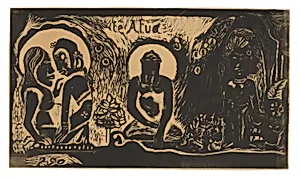
Te atua (The God), from the Noa Noa Suite
1893/94
Medium
Wood-block print in black ink on tan wove paper
Dimensions
Image: 20.3 × 35.4 cm (8 × 13 15/16 in.); Sheet: 20.7 × 35.8 cm (8 3/16 × 14 1/8 in.)
Classification
woodcut
Department
Prints and Drawings
Museum
Art Institute of Chicago
Accession Number
45041
Rights
Public Domain
Art Historical Context
**Te atua (The God from the Noa No Suite** *Paul Gauguin, 1893/94* Wood-block print in black on tan wove paper*Art Institute of Chicago, Prints and Drawings* Paul Gauguin's *Te atua (The God captures the mystical allure of Tahitian spirituality, created shortly after his transformative first voyage to the South Pacific in 1891–93. Part of the rare *Noa Noa Suite*—a series of just 10 woodcuts hand-printed by the artist upon his return to France—this image draws from Gauguin's journal *Noa Noa* ("fragrant" in Tahitian), blending personal reverie with Polynesian mythology. "Te atua" translates to "The God," evoking ancient deities amid lush, exotic landscapes that symbolized Gauguin's rejection of industrialized Europe in favor of primal, spiritual worlds. As a Post-Impressionist innovator, Gauguin pioneered bold woodcut techniques inspired by Japanese ukiyo-e prints and folk traditions. Here, he carved rough, expressive lines into wood blocks, printing stark black ink on warm tan wove paper to achieve a raw, sculptural quality—measuring a compact 20.3 × 35.4 cm. This monochromatic simplicity heightens the work's symbolic power, with flattened forms and rhythmic patterns foreshadowing modern art movements like Fauvism and Expressionism. These prints, produced in tiny editions, represent Gauguin's experimental bridge between painting and printmaking, offering museum visitors a intimate glimpse into his quest for cultural authenticity and artistic freedom. A testament to his enduring influence, *Te atua* invites us to ponder the divine in the everyday exotic.
About the Artist
Paul Gauguin · 1848–1903
Paul Gauguin (1848-1903) was a French Post-Impressionist painter whose bold experiments with color, form, and subject matter made him one of the most influential figures in the transition from 19th-century art to modernism. His rejection of European civilization for the perceived authenticity of 'primitive' cultures established an archetype of artistic exile that continues to resonate. Gauguin's ...