
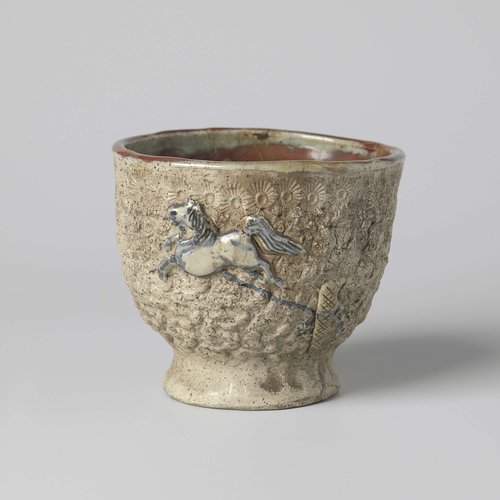
Tea bowl with a running horse
ca. 1800 - ca. 1900
Medium
turning
Dimensions
10.8; 6.7; 9.4
Rights
Public Domain
About this artwork
…; collection of Herman Karel Westendorp (1868-1941), Amsterdam, 1941;{Note RMA.} his widow Betsy Westendorp-Osieck (1880-1968), Amsterdam, by whom bequeathed to the Vereniging van Vrienden der Aziatische Kunst, 1968;{note RMA.} from whom on loan to the museum, 1972
Art Historical Context
This elegant tea bowl, standing 9.4 centimeters high with a diameter of 10.8 centimeters, was created through the ancient technique of turning, in which clay is shaped on a potter’s wheel. Dating from roughly 1800 to 1900, the vessel features a dynamic motif of a running horse, lending a sense of motion and vitality to its simple, functional form. The anonymous maker’s choice of subject matter suggests an appreciation for speed and grace, qualities often celebrated in East Asian decorative traditions. The bowl’s journey through time adds another layer of interest. It once belonged to the noted Dutch collector Herman Karel Westendorp and later passed to his widow, Betsy Westendorp-Osieck, before entering the holdings of the Vereniging van Vrienden der Aziatische Kunst in 1968. Since 1972 it has been on long-term loan to the museum, allowing generations of visitors to appreciate its quiet beauty. As a modest yet finely turned object, the tea bowl exemplifies how everyday utensils could carry both practical and aesthetic value. Its restrained proportions and lively decoration invite close looking, revealing the subtle marks of the wheel and the careful placement of the horse motif.