
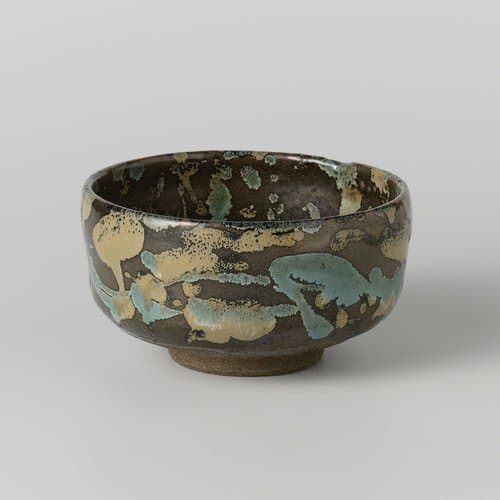
Tea bowl with blue and yellow spots
ca. 1800 - ca. 1899
Medium
turning
Dimensions
7.2; 6.4; 13.2
Rights
Public Domain
About this artwork
…; collection of Herman Karel Westendorp (1868-1941), Amsterdam, 1941;{Note RMA.} his widow Betsy Westendorp-Osieck (1880-1968), Amsterdam, by whom bequeathed to the Vereniging van Vrienden der Aziatische Kunst, 1968;{note RMA.} from whom on loan to the museum, 1972
Art Historical Context
This charming tea bowl, created sometime between 1800 and 1899, exemplifies the quiet elegance of traditional Asian ceramics. Standing just 7.2 centimeters tall with a diameter of 13.2 centimeters, its modest size is perfectly suited for the intimate ritual of tea drinking. The vessel was formed through the technique of “turning,” in which the potter shaped the clay on a wheel, giving the bowl its balanced, tactile form that fits comfortably in the hands. The playful blue and yellow spots that decorate its surface add a lively touch to an otherwise simple vessel, suggesting a maker who valued both function and spontaneous visual delight. Such spotted glazes were often achieved through careful control of kiln conditions, allowing mineral pigments to bloom naturally during firing. Acquired by the Dutch collector Herman Karel Westendorp in the early twentieth century and later bequeathed to the Vereniging van Vrienden der Aziatische Kunst, the bowl has been on long-term loan to the Rijksmuseum since 1972. Its presence in the collection invites visitors to appreciate the enduring appeal of everyday objects that once enriched daily life across Asia.