
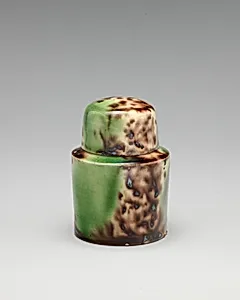
Tea caddy
third quarter 18th century
Medium
Lead-glazed earthenware
Dimensions
Height (with cover): 2 1/8 in. (5.4 cm)
Classification
Ceramics-Pottery
Culture
British, Staffordshire
Department
European Sculpture and Decorative Arts
Museum
Metropolitan Museum of Art, New York, NY
Credit
Gift of Dr. and Mrs. A. L. Garbat, 1961
Accession Number
61.107.131a, b
Rights
Public Domain
Art Historical Context
This charming tea caddy, crafted in Staffordshire during the third quarter of the eighteenth century, exemplifies the refined yet practical ceramics produced in Britain’s leading pottery region. Attributed to the “Whieldon type,” it reflects the innovative spirit of Thomas Whieldon, whose workshop pioneered colorful lead-glazed earthenware that combined functionality with decorative appeal. Standing just over two inches tall, the diminutive vessel—with its fitted cover—would have held precious tea leaves, underscoring tea’s rising status as a luxury commodity among the British middle and upper classes. Staffordshire potters like Whieldon developed sophisticated glazing techniques that created mottled, tortoiseshell-like effects, transforming humble earthenware into objects worthy of the tea table. This piece, now part of the Metropolitan Museum’s European Sculpture and Decorative Arts collection, captures the era’s blend of industrial ingenuity and domestic elegance. Its modest scale and graceful form remind us how everyday rituals, such as tea drinking, inspired some of the period’s most delightful ceramic creations.
About the Artist
Whieldon type
Whieldon-type is not a single artist but a catalogue attribution used by museums for unmarked mid-18th-century Staffordshire earthenware in the manner of Thomas Whieldon (1719-1795), the celebrated English potter of Fenton Vivian. Whieldon perfected lead-glazed cream-colored earthenware streaked and dappled with metallic oxides - manganese browns, copper greens, cobalt blues - producing the mottle...