
Tea Drinking Under the Wutong Tree
Ming dynasty (1369–1644), 1509
Medium
Handscroll; ink and slight color on paper
Dimensions
23.4 × 332.8 cm (9 3/16 × 131 in.)
Classification
painting
Department
Arts of Asia
Museum
Art Institute of Chicago
Accession Number
40558
Rights
Public Domain
About this artwork
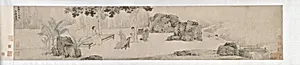
Generations of Chinese intellectuals and Buddhist monks honed the practice of tea tasting into a high art form. The "bamboo stove" —a carrying case that contained a ceramic kettle used for heating water—was central to the process of tea preparation. This ingenious device, fanned by a servant in the center of this painting, was the subject of a poem by Wu Kuan (1435-1504), a close friend of Tang Yin. In this composition, Wu appears on a low platform with a teapot and a scroll by his side. He shar...
Art Historical Context
Created in 1509 during the Ming dynasty, *Tea Drinking Under the Wutong Tree* is a handscroll by Tang Yin, one of the era’s most celebrated scholar-artists. Tang Yin belonged to the Wu School of painting, a circle of literati who valued personal expression, poetry, and refined brushwork over courtly formality. The long format—measuring over three meters—invites viewers to unroll the scene gradually, mirroring the leisurely pace of the gathering it portrays. Painted in ink with delicate touches of color on paper, the scroll captures scholars enjoying tea beneath the wutong tree, a symbol of elegance and seasonal change. Handscrolls like this were intimate objects, often shared among friends rather than displayed publicly, reflecting Ming literati ideals of cultivated retreat and camaraderie. Tang Yin’s fluid brushwork and sensitive use of space highlight both the quiet pleasures of friendship and the artist’s mastery of traditional techniques. Today housed in the Art Institute of Chicago, the painting offers a vivid glimpse into sixteenth-century Chinese cultural life and the enduring appeal of ink painting as a medium for storytelling and reflection.
About the Artist
Tang Yin · 1470–1524
Talented painter whose career as an official painter was ruined by an examination scandal in 1499. Around 1500 he began to study painting with Zhou chen. He was ultimately considered one of the Four Masters of the Ming, along with Shen Zhou, Wen Zhengming and Qiu Ying.