
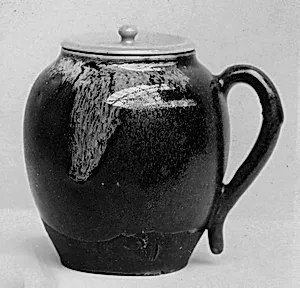
Tea jar
Unknown Artist
1750
Medium
Pottery with handle and ivory-colored lid; Satsuma-like glazes over a light brown ground (Takatori ware)
Dimensions
H. 2 1/2 in. (6.4 cm)
Classification
Ceramics
Culture & Period
Japan · Edo period (1615–1868)
Department
Asian Art
Museum
Metropolitan Museum of Art, New York, NY
Credit
Rogers Fund, 1925
Accession Number
25.60.26a, b
Rights
Public Domain
Art Historical Context
This petite tea jar, created around 1750 during Japan's Edo period (16151868), captures the everyday elegance of domestic life in a time of cultural flourishing and isolation under the shogunate. just 2½ inches (6.4 cm) tall, it was designed for storing tea leaves—a staple of Japanese ritual and social customs—featuring a practical handle, ivory-colored lid, and light brown ground coated in Satsuma-like glazes a subtle, glossy sheen. Takatori ware, originating from kilns in present-day Fukuoka Prefecture, is celebrated for its robust pottery tradition, often blending earthy functionality with decorative touches. The Satsuma-inspired glazes here add a refined luster, evoking the more elaborate ceramics of nearby Kyushu regions, while the compact form highlights the Edo era's appreciation for modest, harmonious objects that enhanced daily routines. Acquired through the Rogers Fund in 1925, this anonymous masterpiece in the Metropolitan Museum of Art's Asian Art collection offers a window into Japan's masterful ceramic heritage, where utility met artistry in the tea ceremony's quiet poetry.