
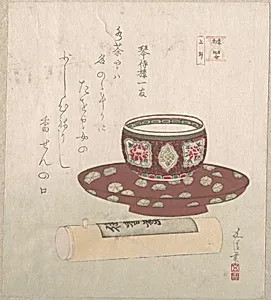
Teabowl and Powder Cake in a Tube
19th century
Medium
Part of an album of woodblock prints (surimono); ink and color on paper
Dimensions
8 1/4 x 7 1/4 in. (21 x 18.4 cm)
Classification
Prints
Culture
Japan
Department
Asian Art
Museum
Metropolitan Museum of Art, New York, NY
Credit
H. O. Havemeyer Collection, Bequest of Mrs. H. O. Havemeyer, 1929
Accession Number
JP2321
Rights
Public Domain
Tags
Art Historical Context
In the serene world of 19th-century Japanese woodblock prints, Sunayama Gosei's *Teabowl and Powder in a Tube* captures the quiet elegance of everyday confections. Part of a luxurious surimono album—privately commissioned prints often exchanged as New Year's greetings—this intimate scene (8 1/4 x 7 1/4 in.) features humble teabowl alongside a powdered cake neatly encased in a tube. Rendered in vibrant ink and color on paper, it exemplifies the ukiyo-e tradition's mastery of subtle textures and harmonious compositions. Surimono like this one were artisanal treasures, produced in limited editions with fine details such as embossing or mica accents (though not specified here), far surpassing commercial prints. Gosei, a lesser-known artist in this genre, highlights Japan's tea culture and seasonal sweets, evoking wabi-sabi aesthetics—beauty in imperfection and transience. These motifs symbolized hospitality and refinement during the Edo period, bridging art and social ritual. Housed in the Metropolitan Museum of Art's Asian Art collection (H. O. Havemeyer Collection, 1929), this print invites visitors to savor the poetry of the mundane, reminding us how ordinary objects become profound in Japanese artistry.