
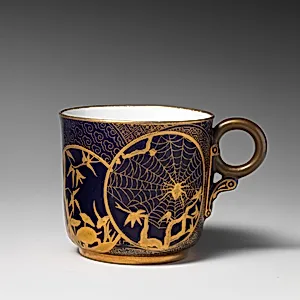
Teacup
1876–77
Medium
Bone china
Dimensions
confirmed: 2 5/8 × 3 3/4 × 2 3/4 in. (6.7 × 9.5 × 7 cm)
Classification
Ceramics-Porcelain
Culture
British, Worcester
Department
European Sculpture and Decorative Arts
Museum
Metropolitan Museum of Art, New York, NY
Credit
Gift of Helene Fortunoff and Robert Grossman, 2017
Accession Number
2018.62.113
Rights
Public Domain
Tags
Art Historical Context
This delicate bone china teacup, by the renowned Worcester factory in Britain around 1876–77, exemplifies the height of Victorian porcelain artistry. Measuring just 2⅝ × 3¾ ×2¾ inches, it belongs to the Metropolitan Museum of Art's European Sculpture and Decorative Arts, gifted in 2017. Worcester, a leader in English ceramics since the 18th century, celebrated for its innovative techniques and luxurious tableware, perfectly suited to the era's tea-drinking rituals that symbolized refinement and social grace. Bone china, the medium here, revolutionized porcelain production with its addition of bone ash, yielding a translucent, ivory-white body that's both durable and elegantly lightweight—ideal for everyday elegance. The Worcester factory excelled in hand-painted and transfer-printed designs, blending functionality with ornamental flair during the Industrial Age's decorative boom. A standout feature is its spider motifs (noted in curatorial tags), an unusual choice for teaware that may nod to Victorian fascination with natural history and gothic whimsy, transforming a simple cup into a conversation piece. Sip from history with this charming survivor of 19th-century British culture!
About the Artist
Worcester factory · 1751–2008
The Worcester porcelain factory, established in 1751 in Worcester, England, by physician Dr. John Wall and apothecary William Davis along with 14 partners, marked the birth of one of Britain's most enduring ceramic enterprises. Investing £4,500 at Warmstry House on the River Severn, the founders drew on contacts with the Bristol porcelain manufactory to develop a novel soft-paste porcelain using s...