
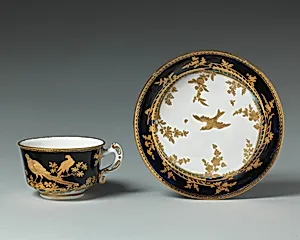
Teacup (one of 8) (part of a service)
ca. 1758–69
Medium
Soft-paste porcelain
Dimensions
Overall (.18): 1 3/4 × 2 15/16 in. (4.4 × 7.5 cm);
Classification
Ceramics-Porcelain
Culture
British, Chelsea
Department
European Sculpture and Decorative Arts
Museum
Metropolitan Museum of Art, New York, NY
Credit
Gift of Mrs. Francis P. Garvan, in memory of Francis P. Garvan, 1954
Accession Number
54.163.18
Rights
Public Domain
Tags
Art Historical Context
This delicate teacup, one of eight from a porcelain tea service crafted by the Chelsea Porcelainufactory around 1758–69, exemplifies the golden age of British ceramics. Produced in London at the renowned Chelsea factory—one of England's earliest porcelain makers—this soft-paste porcelain piece measures a dainty 1¾ × 2⅞ inches, perfect for the intimate ritual of tea drinking. Adorned with vibrant motifs of peacocks and pheasants it captures the exuberance of mid-18th-century decorative arts. Soft-paste, a British innovation blending clay, glass frit, and white ash, allowed Chelsea artisans to mimic the translucency of coveted Chinese and Meissen wares while enabling intricate hand-painted enamels. The exotic birds, symbols of opulence and nature's splendor, reflect the Rococo taste for playful, naturalistic designs among the elite. Tea services like this one fueled a booming consumer culture, as afternoon tea became a social staple in Georgian Britain. Today, this teacup graces the Metropolitan Museum of Art's European Sculpture and Decorative Arts collection, a generous gift honoring Francis P. Garvan. It whispers of craftsmanship and refinement, inviting us to savor the elegance of a bygone era.
About the Artist
Chelsea Porcelain Manufactory · 1744–1784
**Chelsea Porcelain Manufactory** The Chelsea Porcelain Manufactory, Britain's pioneering porcelain enterprise, was founded around 1743 in Chelsea, London, by two Huguenot silversmiths: Nicholas Sprimont from Liège and Charles Gouyn. Sprimont, trained in Paris as a goldsmith before immigrating to England, brought his expertise in luxury metalwork to the venture, while Gouyn handled early sales th...