
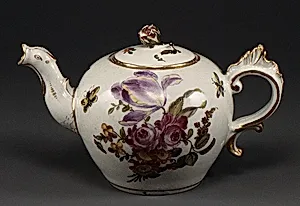
Teapot
ca. 1740
Medium
Hard-paste porcelain
Dimensions
4 3/8 × 6 3/4 in. (11.1 × 17.1 cm)
Classification
Ceramics-Porcelain
Culture
German, Meissen
Department
European Sculpture and Decorative Arts
Museum
Metropolitan Museum of Art, New York, NY
Credit
Bequest of John L. Cadwalader, 1914
Accession Number
14.58.38a, b
Rights
Public Domain
Tags
Art Historical Context
This elegant teapot from Meissen Manufactory, dating to around 1740, exemplifies pinnacle of early European porcelain production. Crafted in hard-paste porcelain—a breakthrough material developed by Meissen in 1710 that rivaled the translucent durability of Chinese imports—this piece measures a dainty 4 3/8 × 6 3/4 inches, perfect for the intimate rituals of 18th-century tea drinking As the first European factory to master this formula under Augustus the Strong, Elector of Saxony, Meissen elevated ceramics from utilitarian objects to luxurious art forms. Adorned with delicate motifs of birds, butterflies, and blooming roses, the teapot reflects the exuberant Rococo style popular in mid-18th-century Germany. Artisans employed meticulous techniques like overglaze enameling and gilding to bring these natural elements to life, showcasing the factory's renowned precision and whimsy. Such decorations not only highlighted technical virtuosity but also evoked the era's fascination with nature's fleeting beauty amid aristocratic opulence. Housed in the Metropolitan Museum of Art's European Sculpture and Decorative Arts department, this teapot—bequeathed by John L. Cadwalader in 1914—reminds us how Meissen porcelain fueled a cultural craze, making elite Chinese luxury accessible and spurring innovation across Europe. A true gem for any visitor!
About the Artist
Meissen Manufactory · 1710–present
The Meissen Manufactory, established on June 6, 1710, by Augustus the Strong, Elector of Saxony and King of Poland, marked the dawn of true hard-paste porcelain production in Europe. Nestled at Albrechtsburg Castle in Meissen near Dresden, the Royal Polish and Electoral Saxon Porcelain Manufactory arose from alchemical experiments begun in 1708 by physicist Ehrenfried Walther von Tschirnhaus and p...