
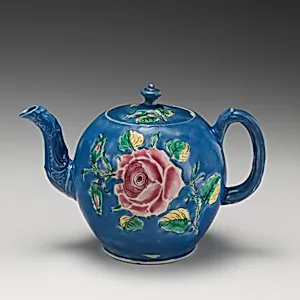
Teapot
Unknown Artist
ca. 1765
Medium
Salt-glazed stoneware with enamel decoration
Dimensions
Overall: 4 1/4 × 6 1/4 in. (10.8 × 15.9 cm)
Classification
Ceramics-Pottery
Culture
British, Staffordshire
Department
European Sculpture and Decorative Arts
Museum
Metropolitan Museum of Art, New York, NY
Credit
Gift of Carleton Macy, 1934
Accession Number
34.165.168a, b
Rights
Public Domain
Tags
Art Historical Context
This charming teapot, crafted around 1765 in Staffordshire, England, exemplifies the region's renowned ceramic tradition. Made of salt-glazed stoneware durable, practical medium achieved by vaporizing salt in the kiln to form a hard, glossy surface—the piece measures a modest 4¼ × 6¼ inches, perfect for intimate tea gatherings. Delicate enamel decoration, applied over the glaze and fired at lower temperatures, adorns it with motifs of roses and leaves, evoking the natural elegance popular in mid-18th-century Britain. Staffordshire potteries, like those in Stoke-on-Trent, revolutionized affordable tableware during the Industrial Revolution's early stirrings, blending functionality with decorative flair. Salt-glazing, perfected there since the 17th century, produced wares resistant to chipping and ideal for everyday use, while enamel allowed vibrant, colorful embellishments that mimicked costlier porcelain imports from China. In an era when tea drinking surged among the growing middle class—fueled by East India Company imports—this teapot symbolized refined domesticity. Donated to the Metropolitan Museum of Art in 1934, it offers a glimpse into Georgian leisure, where floral designs like these roses and leaves celebrated nature's bounty amid urbanizing society. A delightful survivor of its time!