
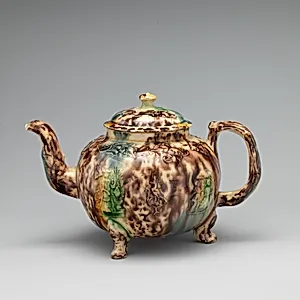
Teapot
ca. 1760
Medium
Lead-glazed earthenware
Dimensions
Height: 4 1/8 in. (10.5 cm)
Classification
Ceramics-Pottery
Culture
British, Staffordshire
Department
European Sculpture and Decorative Arts
Museum
Metropolitan Museum of Art, New York, NY
Credit
Gift of Mrs. Russell S. Carter, 1944
Accession Number
44.39.30a, b
Rights
Public Domain
Art Historical Context
This charming teapot, classified as "Whieldon type," hails from Staffordshire, England, around 1760, a golden era for British ceramics. Crafted from lead-glazed earthenware, it stands just 4 1/8 inches (10.5 cm) tall, making it a delightful, domestic object perfect for the tea tables of the emerging middle class. Thomas Whieldon, the innovative potter whose style this embodies, was a pioneer in Staffordshire's pottery industry, renowned for producing affordable yet vividly colored wares that brought luxury within reach. The lead glaze—a hallmark technique—provided a glossy, durable finish while allowing for playful mottled effects in tortoiseshell or cloud patterns, though specifics here reflect the era's whimsical experimentation. During the mid-18th century, Britain's tea obsession fueled demand for such teapots, transforming everyday rituals into fashionable affairs. Staffordshire potters like Whieldon scaled production, laying groundwork for giants like Wedgwood and elevating earthenware from utilitarian to artistic. Now in the Metropolitan Museum of Art's European Sculpture and Decorative Arts collection (gift of Mrs. Russell S. Carter, 1944), this piece whispers of 18th-century innovation and social change. Visitors, imagine sipping tea from it amid the clink of porcelain rivals—pure Staffordshire magic!
About the Artist
Whieldon type
Whieldon-type is not a single artist but a catalogue attribution used by museums for unmarked mid-18th-century Staffordshire earthenware in the manner of Thomas Whieldon (1719-1795), the celebrated English potter of Fenton Vivian. Whieldon perfected lead-glazed cream-colored earthenware streaked and dappled with metallic oxides - manganese browns, copper greens, cobalt blues - producing the mottle...