
Teaspoon
Unknown Artist
ca. 1770–80
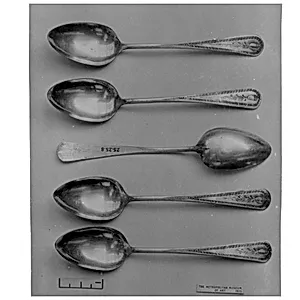
Medium
Sheffield plate
Dimensions
Length: 4 3/4 in. (12.1 cm)
Classification
Metalwork-Silverplate
Culture
British, Sheffield
Department
European Sculpture and Decorative Arts
Museum
Metropolitan Museum of Art, New York, NY
Credit
Gift of Frederick Bradbury, 1925
Accession Number
25.25.8
Rights
Public Domain
Art Historical Context
This delicate teaspoon, crafted around 1770–80 in Sheffield, England, exemplifies the ingenuity of British metalwork during the Georgian era. Measuring just 4 3/4 inches (12.1 cm), it was fashioned from Sheffield plate—a groundbreaking technique developed in the mid-18th century that fused a thin layer of silver onto a copper core through a rolling process. Invented locally by Thomas Boulsover around 1743, this method democratized luxury tableware, offering the gleam of silver at a fraction of the cost of solid sterling pieces. Tea drinking had exploded in popularity across Britain by the late 1700s, fueled by imports from China and the rise of domestic rituals among the growing middle class. Such teaspoons were essential for afternoon tea service, blending everyday utility with refined elegance. Produced in Sheffield's bustling workshops—Europe's metalworking hub—this example highlights the region's mastery of mass production without sacrificing quality, making fine dining accessible beyond the aristocracy. Today, housed in the Metropolitan Museum of Art's Department of European Sculpture and Decorative Arts (gift of Frederick Bradbury, 1925), it invites us to savor a slice of social history: a small object that stirred conversations over countless cups of tea.