
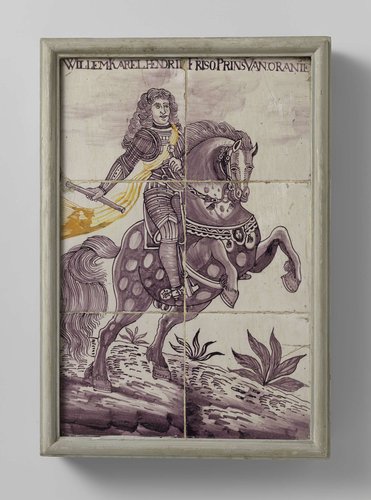
Tegeltableau met portret prins Willem IV te paard, met opschrift: WILLEM KAREL HENDRIK FRISO PRINS VAN ORANIE
1760 - 1795
Medium
maiolica
Dimensions
5; 29; 42.5
Rights
Public Domain
About this artwork
Tegeltableau van 6 tegels (3 x 2) met een veelkleurig (paars en geel) geschilderd portret van prins Willem IV te paard. Aan de bovenkant, het opschrift: WILLEM KAREL HENDRIK FRISO PRINS VAN ORANIE.
Art Historical Context
This striking *Tegeltableau metret prins Willem IV te* is a finely crafted panel of six maiolica tiles arranged in a 3x2 grid, measuring 42.5 cm high by 29 cm wide. Created anonymously between 1760 and 1795, it features a, multicolored portrait—highlighted by rich purples and yellows—of Prince Willem IV (Willem Karel Hendrikiso), depicted confidently astride his horse. The inscription at the top proudly proclaims his full title: *WILLEM KAREL HENDRIK FRISO PRINS VAN ORAN*, celebrating the prominent Dutch stadtholder who ruled the Republic from 1747 until his early death in 1751. Maiolica, a tin-glazed earthenware prized in the Netherlands during the 18th century, allowed for brilliant overglaze colors and durable decorative panels like this one. Often produced in workshops inspired by Delft traditions, these *tegeltableaux* adorned homes, taverns, and public spaces, blending functionality with artistry. The equestrian pose evokes heroic portraits of nobility, underscoring Willem IV's legacy as a unifying figure amid political tensions in the Dutch Golden Age's twilight. As a commemorative work post-dating the prince's life, it reflects enduring Orange loyalty and the cultural role of tile art in preserving history for everyday viewers—inviting us to imagine it gleaming on a period wall.
About the Artist
anonymous
In the vast tapestry of art history, "Anonymous" stands not as a singular individual but as a collective designation for countless unidentified creators whose works have endured across millennia. These artists, spanning prehistoric cave painters to medieval illuminators and folk craftsmen, produced the foundational layers of human visual culture. Prior to the Renaissance, when individual fame emer...