
Tegeltableau van twaalf tegels
1775 - 1825
Medium
maiolica
Dimensions
4.9; 41.5; 55.2
Rights
Public Domain
About this artwork
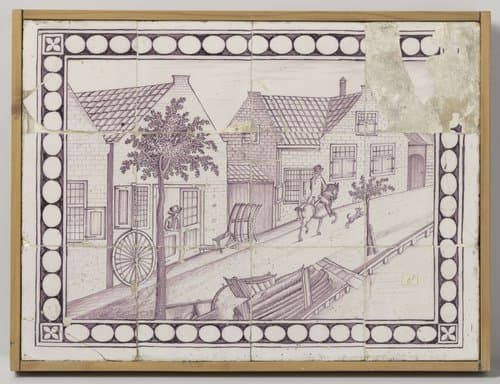
Tegeltableau van 12 tegels (3 x 4) met een paars geschilderde voorstelling van een werkplaats waar rijtuigen worden gemaakt van de straatkant gezien. De voorstelling is omgeven door een eierlijst met rozetten in de hoeken. Zie pendant: BK-NM-5197.
Art Historical Context
This charming *Tegeltableau van twaalf tegels* (Tile Tableau of Twelve Tiles), created anonymously between 1775 and 1825, offers a vivid glimpse into everyday urban life through maiolica—a tin-glazed earthenware prized for its bright colors and durability. Composed of twelve tiles arranged in a 3x4 grid (measuring 41.5 x 55.2 x 4.9 cm), it depicts a bustling workshop where carriages are crafted, viewed from the street side. The purple-painted scene captures the energy of skilled laborers at work, framed elegantly by an egg-and-dart molding (eierlijst) with rosettes in the corners, adding a touch of architectural refinement. Maiolica tiles like this were a staple of Dutch interiors during the late 18th and early 19th centuries, often adorning fireplaces, walls, or risers in prosperous homes. The purple palette, likely achieved through specialized glazes fired at high temperatures, highlights the technical prowess of anonymous tile painters, who blended functionality with artistry. Such panels celebrated local trades, reflecting the economic vibrancy of coach-making amid growing urbanization and trade. This piece has a pendant counterpart (BK-NM-5197), suggesting it was designed as part of a pair to create balanced decorative ensembles. For visitors, it evokes the tactile beauty of ceramic art—cool to the touch yet alive with historical stories of craftsmanship and community.
About the Artist
anonymous
In the vast tapestry of art history, "Anonymous" stands not as a singular individual but as a collective designation for countless unidentified creators whose works have endured across millennia. These artists, spanning prehistoric cave painters to medieval illuminators and folk craftsmen, produced the foundational layers of human visual culture. Prior to the Renaissance, when individual fame emer...