
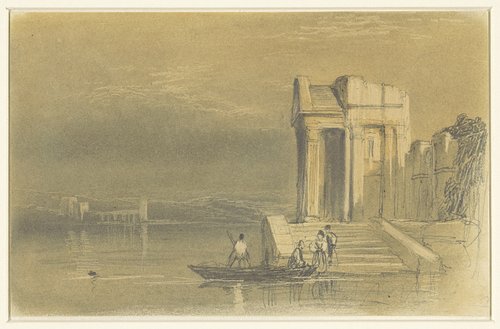
Tempelruïnes aan een meer in een Italiaans landschap
1803 - 1867
Medium
paper
Dimensions
205; 130
Rights
Public Domain
About this artwork
potlood
Art Historical Context
William Clarkson Stanfield’s delicate pencil drawing *Tempelruïnes aan een meer in een Italiaans landschap* captures the timeless allure of classical ruins set beside a tranquil lake. Though modest in scale—just 130 by 205 millimetres—the work exemplifies the Romantic fascination with Italy that captivated British artists during the nineteenth century. Stanfield, best known for his dramatic marine paintings, here turns his eye toward the picturesque remnants of antiquity, evoking both the grandeur of ancient civilisation and the gentle melancholy of its decay. Pencil on paper allowed Stanfield to work quickly and with great sensitivity, recording the play of light across crumbling columns and the soft reflections on the water. Such on-the-spot studies were essential to artists of his generation, who often travelled through Italy as part of the extended Grand Tour tradition. The small format invites close viewing, rewarding the visitor with fine details that reveal Stanfield’s precise yet atmospheric handling of line. Today the drawing offers a quiet window onto both the Italian landscape and the artistic practices of the Romantic era. It reminds us how even a simple sketch could distil the enduring appeal of ruins—symbols of beauty, memory, and the passage of time.